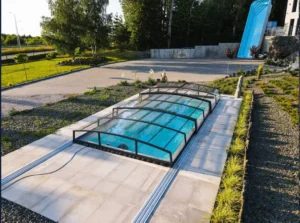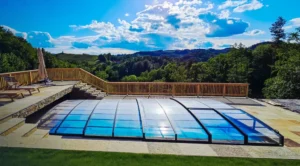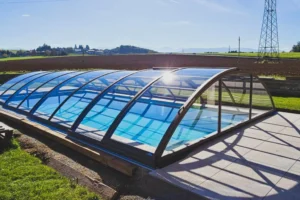
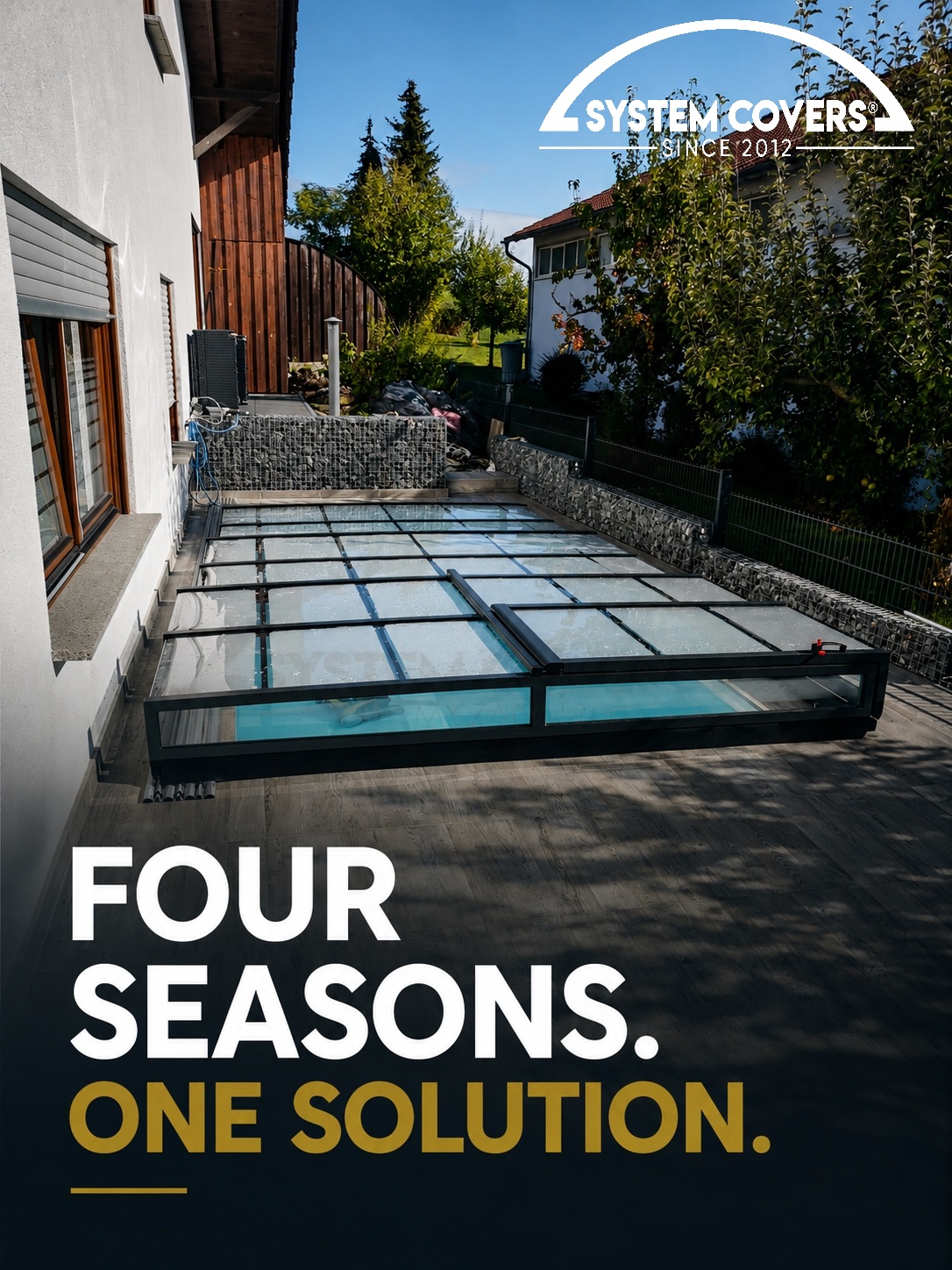
Santorini is the lowest enclosure in the System Covers range — a classic minimalist arch of 40-60 cm. The Polish climate tests it year-round: frost and snow in winter, pollen and rain in spring, UV and heat in summer, leaves and humidity in autumn. In this article, we break down season by season how the low-profile structure copes in our conditions and which elements are responsible for it.
Santorini — model characteristics

Santorini opens the System Covers offer from the low-profile side. The gentle arch of 40-60 cm makes the enclosure almost disappear in the garden — the water surface is visible, not the structure. This is a choice for those who primarily view the enclosure as protection for the pool: against contaminants, heat loss, and access by children — rather than as a space to spend time in.
Winter — frost, snow, wind

The Polish winter can drop to -17°C and lower (IMGW data for 2025: minimum -17.7°C in Jelenia Góra), and historically, temperatures of -25/-30°C have been recorded. Three elements of the Santorini structure are responsible for its winter resistance:
- Low arch = natural snow shedding. The arched shape prevents snow from lying flat — the cover slides off the polycarbonate. The low height additionally reduces exposure to wind.
- Aluminum 6060 + laser welding. Laser-welded profiles have no twisted points that could loosen during freeze/thaw cycles. The structure remains rigid for years.
- EPDM seals. The operating range of EPDM is from -50°C (according to Superseal.pl) — the Polish winter does not approach the material’s limit. The seals do not crumble or crack in frost.
Before winter, it is advisable to perform a short inspection: check locks, clean rails, verify the condition of seals — details in our enclosure maintenance guide.
Spring and summer — pollen, UV, heat
Spring in Poland is the pollen season — birch, grasses, mugwort. For the owner of an open pool, this means a yellow coating on the surface and clogged filters. Santorini seals the pool tightly: pollen, dust, and insects stay outside. Side effect: reduced chemical usage and less frequent filter cleaning — full breakdown in article on protection against pollution.
In summer, polycarbonate works: solid 3 mm with a double-sided UV filter (optionally 4 mm). Temperatures up to +36°C (IMGW 2025: maximum +36.6°C in Kozienice) are not a problem for the material — polycarbonate works thermally, and this is compensated by EPDM seals and installation gaps. The UV filter protects the sheet from yellowing and cracking for 10-15 years of use (according to industry studies).
Autumn — leaves, moisture, preparation for winter

Autumn is the season when the low enclosure pays for itself the most. Leaves, needles, and rainwater stay on the polycarbonate instead of in the water. In practice, this means:
- Clean water for longer — without daily leaf scooping with a net.
- Longer season — the water under the enclosure loses heat more slowly, swimming possible until October.
- Easier season closure — the pool is closed clean, without decaying organic matter at the bottom.
Preparing Santorini for winter comes down to three steps: washing the polycarbonate with gentle agents, checking and closing windproof locks, inspecting seals. No complicated procedures — the structure is designed for year-round outdoor use.
Materials responsible for durability in Polish conditions
Santorini uses a full set of SC materials — without compromising quality despite the lowest price in the offer:
| Element | Material / solution | Role in Polish climate |
|---|---|---|
| Structure | Aluminium 6060, profiles 40×50 (option 80×50) | No corrosion, rigidity in freeze-thaw cycles |
| Connections | Laser welding | No screwed points loosening over time |
| Cladding | Solid polycarbonate 3 mm UV (option 4 mm) | Resistance to hail, UV, temperatures -30 to +36°C |
| Seals | Durable EPDM | Flexibility from -50°C, resistance to UV and chemicals |
| Finish | Powder coating, any RAL | Weather-resistant coating |
| Rails | Anodized aluminum | Smooth sliding regardless of the weather |
Learn more about material differences between market segments — in the premium vs budget article.
Frequently Asked Questions (FAQ)
Yes — the arched shape naturally sheds snow, and the aluminum 6060 laser-welded structure has been working in Polish winters for years. In areas with heavier snowfall (mountains), it is advisable to consider reinforced profiles 80×50 — the configuration is selected individually during the pricing stage.
No — with a height of 40-60 cm, the water surface is too close to the polycarbonate. Santorini is a protective enclosure. If you want to swim under the cover, choose Bali (semi-reclining position) or medium and high models.
No. The enclosure is designed for year-round outdoor use. Before winter, a review is sufficient: cleaning, checking locks and seals. The closed enclosure protects the pool throughout the winter.
Polycarbonate works thermally — it expands in heat and contracts in frost. The SC structure compensates for these movements through EPDM seals and appropriate installation clearances. The double-sided UV filter protects the sheet from solar degradation for 10-15 years.
Yes — standard for typical lowland conditions, in a reinforced version (80×50) for mountainous and coastal areas with stronger winds. SC structures in the reinforced version also reach Sweden and Norway.
Santorini is the lowest price point in the SC offer. The specific amount depends on the pool dimensions and configuration — a full breakdown of price components can be found in the enclosure pricing article. The quote is free and non-binding.
Do you want a Santorini enclosure tailored to your pool?
The quote is free and non-binding. Provide the pool dimensions, location, and preferred RAL color. We will advise on the configuration for your region — standard or reinforced version.