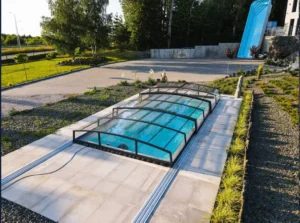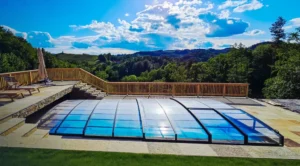
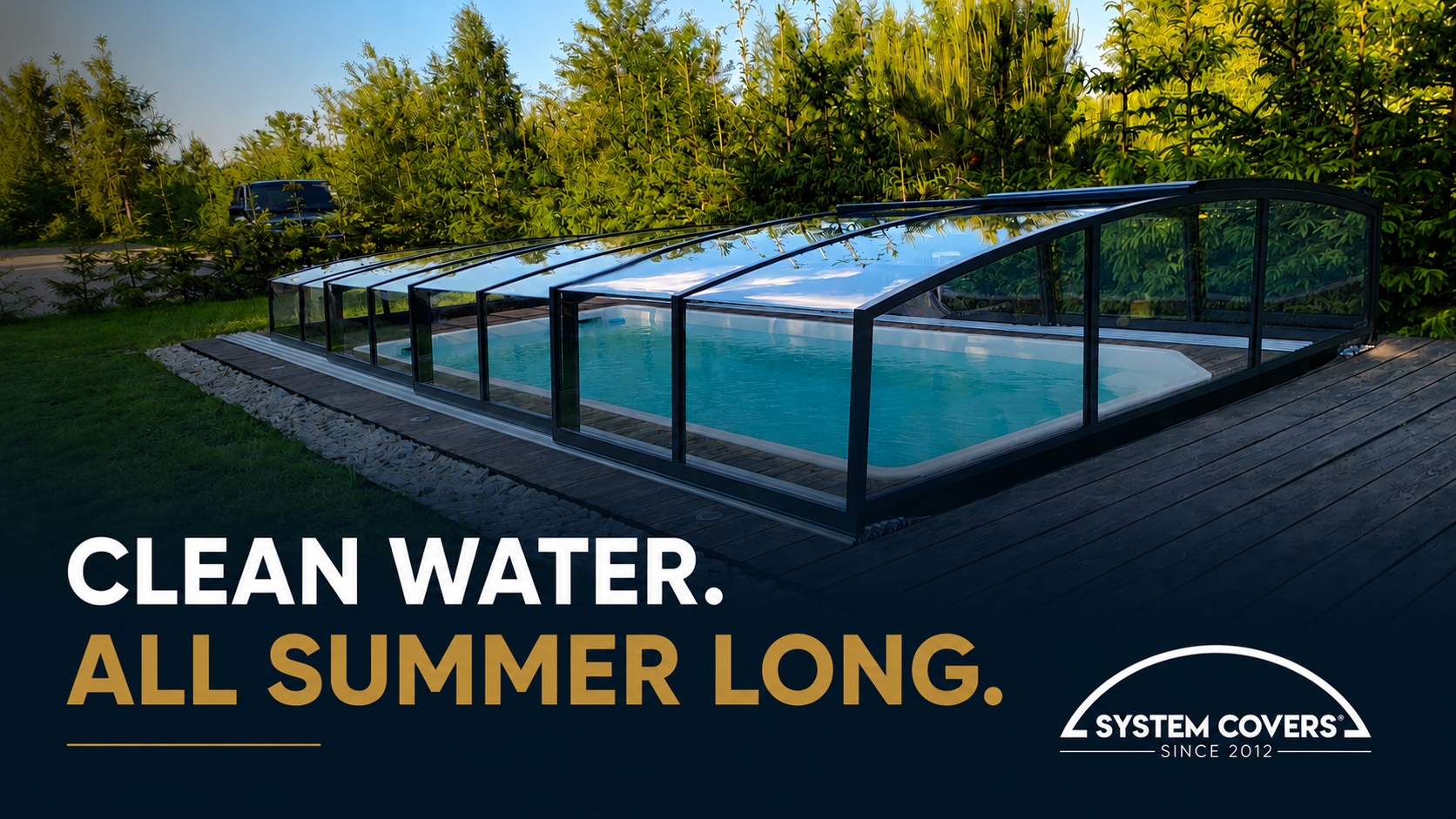
An open pool during the season is a constant target for insects, leaves, and pollen from the surroundings. Mosquitoes come in the evening, wasps search for water at noon, and ants approach the edge of the pool. Leaves falling from trees, needles from spruces and thuja growing around the garden. Pollen carried by the wind for several weeks during the season. Daily cleaning with a skimmer or net is a standard part of using a pool without an enclosure. Under a closed enclosure, this whole process looks different — and this mechanism is what we will break down in this article.
Three categories of contaminants in an open pool
Each of the three sources of contamination appears at a different rhythm and requires a different operational approach. The protection mechanism provided by the enclosure works slightly differently for each of these categories.
Insects
Mosquitoes, wasps, bees, ants. They appear throughout the season, with intensity increasing on hot days. Some (wasps) treat the pool as a source of water.
Leaves and needles
Especially in gardens with trees or near hedges. In autumn, leaves fall en masse, while in summer, there is a constant light shedding of needles from spruces, thujas, and pines.
Pollen
A seasonal problem — most intense during the flowering period of trees and grasses. Pollen is visible on the water’s surface as a yellow-green coating.
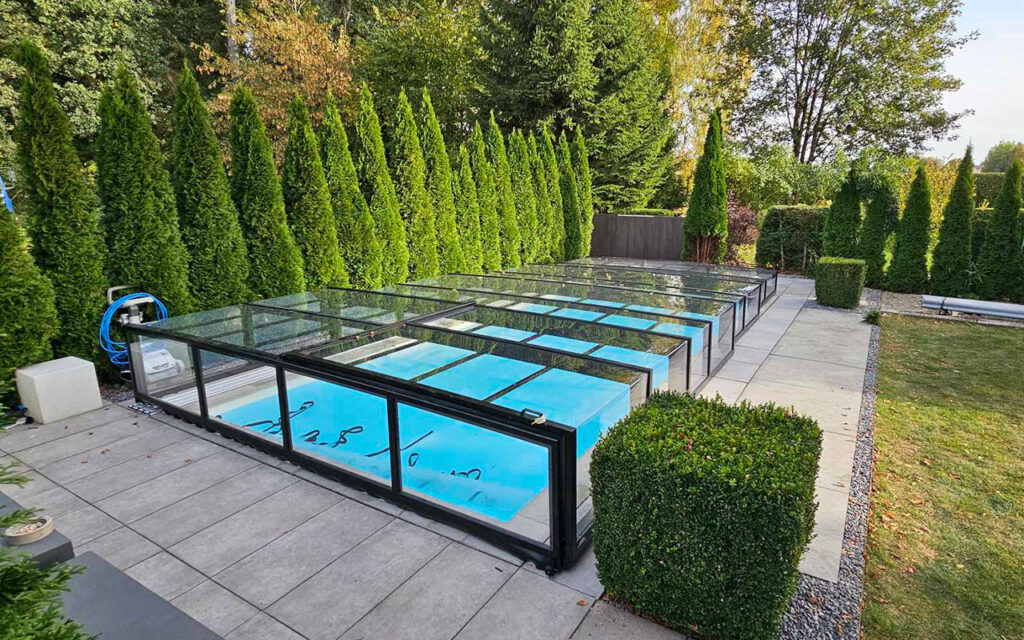
Protection against insects
Of the three categories of contaminants, insects are the most diverse in terms of behavior — and as a result, protection against them works differently depending on the species.
- Mosquitoes. They mainly appear in the evening and at night when the open pool is unused. Standing, warm water is attractive for laying eggs. Under a closed enclosure, mosquitoes have no physical access to the surface — tightly sealed panels block their entry.
- Wasps. They come over the open pool on hot days, searching for a source of water. Danger: wasps can be aggressive towards bathers. Under a closed enclosure, the problem physically disappears — a wasp cannot reach the surface.
- Bees. Like wasps, they seek water in the heat. From an ecological perspective, bees are beneficial — protection by the enclosure is not only for the safety of bathers but also for the protection of the insects themselves (drowned bees are a common problem in open pools).
- Ants. They approach the edge of the pool basin with the ground around it. The casing mounted around the perimeter creates a mechanical barrier in the edge zone — rails and structure block access from ground level.
Protection against leaves and needles
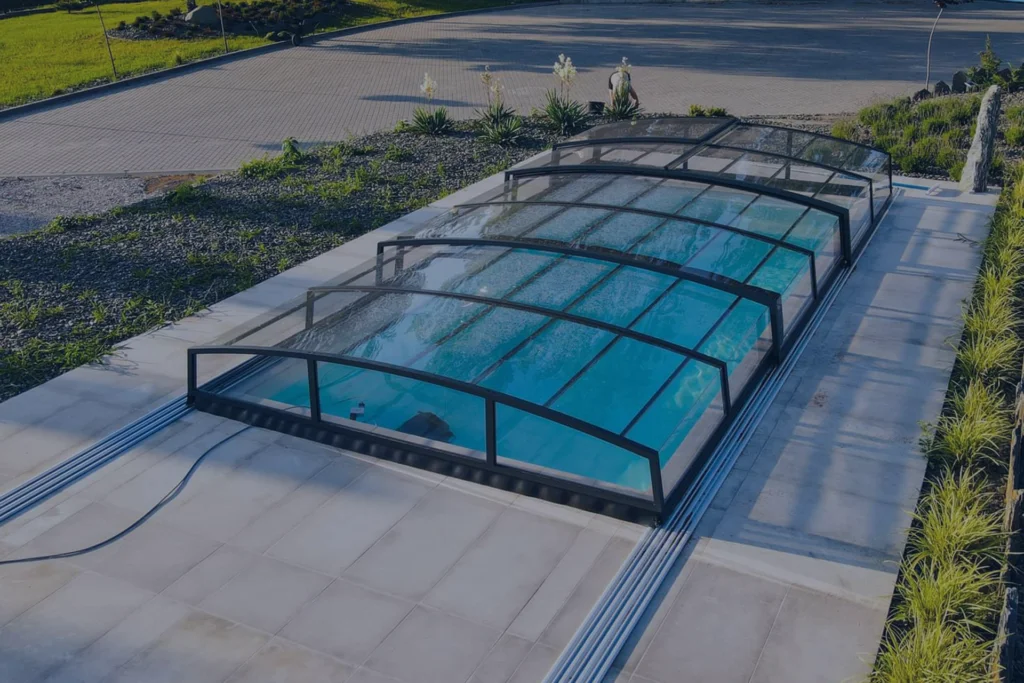
Leaves and needles are two different logistical problems. Leaves fall seasonally — mainly in autumn, massively over a few weeks. Needles fall throughout the year, in smaller amounts but continuously.
Without the casing, each category requires regular cleaning with a net or skimmer. Leaves falling on the surface quickly absorb water and sink, where they begin to decompose organically — this increases the demand for chlorine and can lead to clarity issues in the water.
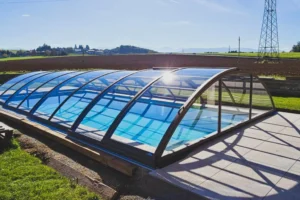
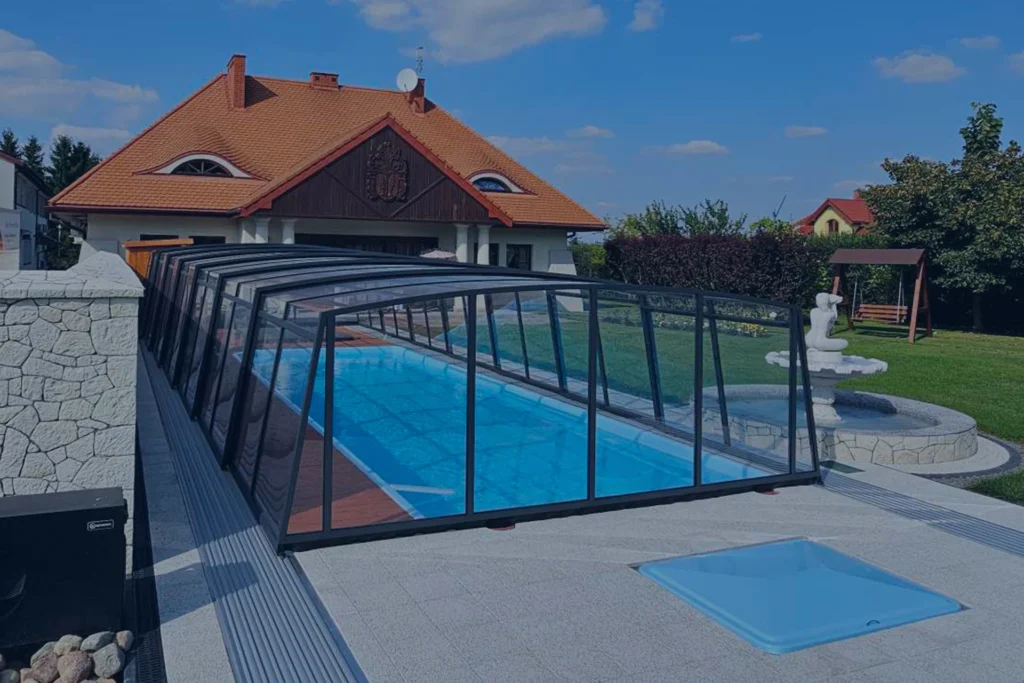
Under the closed casing, leaves and needles fall onto the outer surface of the roof and side panels. The arched design of the Dominicana, Maledives, Rodos, and Tenerife models directs precipitation and falling organic matter along the curve towards the ground — before they reach the water surface. Low-profile models (Santorini, Bali) protect just as effectively, although falling elements stop on the flat roof and require periodic shaking when the casing is normally opened.
Consequence for maintenance: significantly less organic matter entering the water, less chlorine consumed for oxidation, more stable clarity. The full mechanism of the casing’s impact on pool chemical consumption is elaborated in a separate article.
Protection against pollen
Pollen is the most seasonal of the three problems. The most intense period lasts a few weeks — mainly during the flowering of trees (April-May) and grasses (June). Pollen is carried by the wind over long distances, so it affects even gardens far from trees.
On an open surface, pollen settles as a yellow-green coating. The aesthetics of the water change quickly — even a pool recently cleaned can look „dirty” after a day of intense pollination. Pollen is not chemically dangerous in itself, but it is an additional organic fraction that the filter and chemicals must handle.
Periodic rinsing of the outer surface of the panels with water from a hose is enough to remove the settled layer of pollen.
Technical mechanism — polycarbonate plus EPDM seals
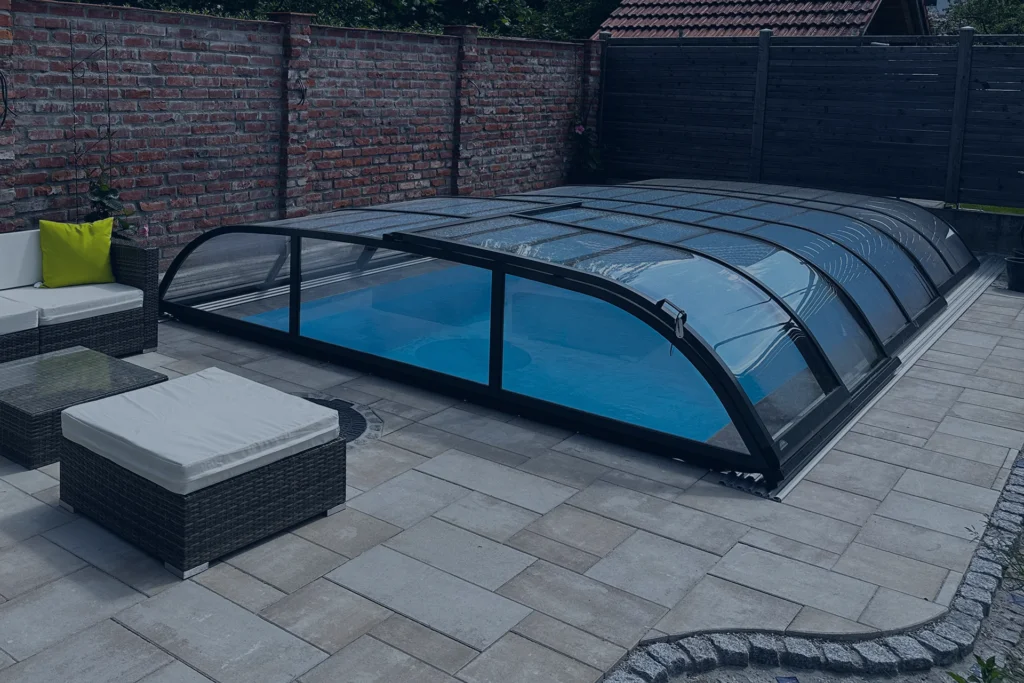
From a technical perspective, the protection of the casing works on two levels: the surface of the panels and the tightness of the joints.
- Solid 3mm polycarbonate with a double-sided UV filter. A solid, uniform physical barrier. It has no holes, perforations, or places through which pollen or small insects could enter. The material is resistant to hail and mechanical impacts — it maintains its tightness even under severe weather conditions.
- Durable EPDM seals. All connections of aluminum profiles with polycarbonate panels and connections between segments are sealed with EPDM. This material is resistant to frost, UV, and pool chemicals — it maintains tightness for many years without degradation such as cracking or crumbling.
- Telescopic system with tight transitions. Segments slide into each other with EPDM seals on each contact line. When closed, the casing forms one continuous barrier without gaps through which small insects or pollen could pass.
Consequence for the customer: protection against contamination does not depend on user activity. Once the casing is closed, the pool is physically isolated from the surroundings without the need for additional security measures.
Limits of protection — when contaminants do get in
The pool casing is not hermetic in a laboratory sense. Three situations in which contaminants do enter the water:
- Open enclosure during use. When the segments are opened (swimming, sunny afternoon), the pool temporarily functions as open. Leaves blown by the wind, pollen, sometimes insects — everything can get in. Once the enclosure is closed for the next use, the contaminants that managed to enter remain inside.
- Partial opening (e.g., a single segment). Some users leave one segment ajar for ventilation. This reduces protection in that area, but still limits contaminants compared to full opening.
- Transport by bathers. Leaves brought in on hair, needles on swimsuits, pollen on skin — these are contaminants that the enclosure does not stop, as they come in with people.
Despite these limitations, the difference in scale is dramatic. An open pool in the season requires daily skimming with a net. A pool under an enclosure — periodic, once a week or less, depending on usage.
Frequently Asked Questions (FAQ)
Practically yes, with a caveat. Once the enclosure is closed, no insect has access to the water surface — the airtight EPDM seals and solid polycarbonate panels block passage. Insects can only get in when the enclosure is open (swimming, ventilation, partial opening). This is a dramatic difference compared to an open pool, where insects are a constant part of the day.
No. Mosquitoes need access to water to develop — the male flies in, lays eggs, and larvae develop in standing water. Under a closed enclosure, mosquitoes have no way to enter, so the developmental cycle does not occur. If someone fell in before closing the enclosure or a female managed to lay eggs, the larvae will hatch — but chlorinated pool water is hostile to them, and in our climate, a typical filtration cycle is sufficient to prevent population growth.
Yes, physically. This is one of the specific arguments from families with small children — wasps by an open pool are a real threat, especially if someone in the household is allergic. Under a closed enclosure, the problem disappears. However, it should be noted that a wasp can fly in during the opening of segments for swimming — in that case, it’s worth ensuring it has exited before closing.
A pool enclosure is the optimal solution for gardens with trees. Leaves fall on the roof of the enclosure instead of on the water surface. Arched models (Maledives, Rodos, Dominicana, Tenerife) naturally direct leaves along the curve towards the ground. Low-profile models (Santorini, Bali) require periodic shaking off from the flat roof, most often during regular opening of the enclosure for swimming.
No. Solid 3 mm polycarbonate is a uniform material, without pores or perforations. Pollen settles on the outer surface of the panels but does not pass inside. This is a key difference compared to insect screens or perforated tarps — which allow pollen and fine contaminants to pass through.
Best practice — before closing the enclosure, check if any insects have remained inside that flew in during use. Most will fly out on their own when they notice a gap. If they are trapped inside, under typical conditions they will die within a few hours or drown — then they will be noticed and removed during the next opening.
Depending on the intensity of use and surroundings, but typically once a week or less. With an open pool, daily skimming is standard. Under the enclosure — periodic checks and possible removal of a few leaves or insects that got in during swimming. The filter and pool chemicals work much more efficiently then, as they do not have to handle a constant influx of organic matter.
Yes, and significantly. Needles are one of the most troublesome contaminants of an open pool — small, sharp needles settle on the entire surface of the water and are difficult to catch with a net (they pass through the mesh). Under the enclosure, needles stop on the outer surface of the roof and side panels — periodic rinsing with a hose is enough to maintain a clean surface.
Do you want an enclosure for your pool in your garden?
The quote is free and includes model selection based on the type of garden (surrounded by trees, wind exposure, proximity to hedges), RAL color for the facade, number of segments, and transport to your home — all in one price KPL.