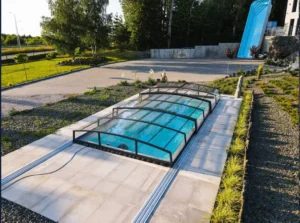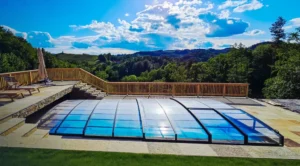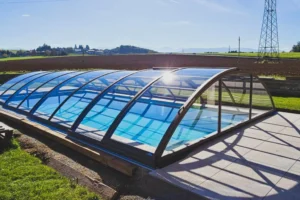
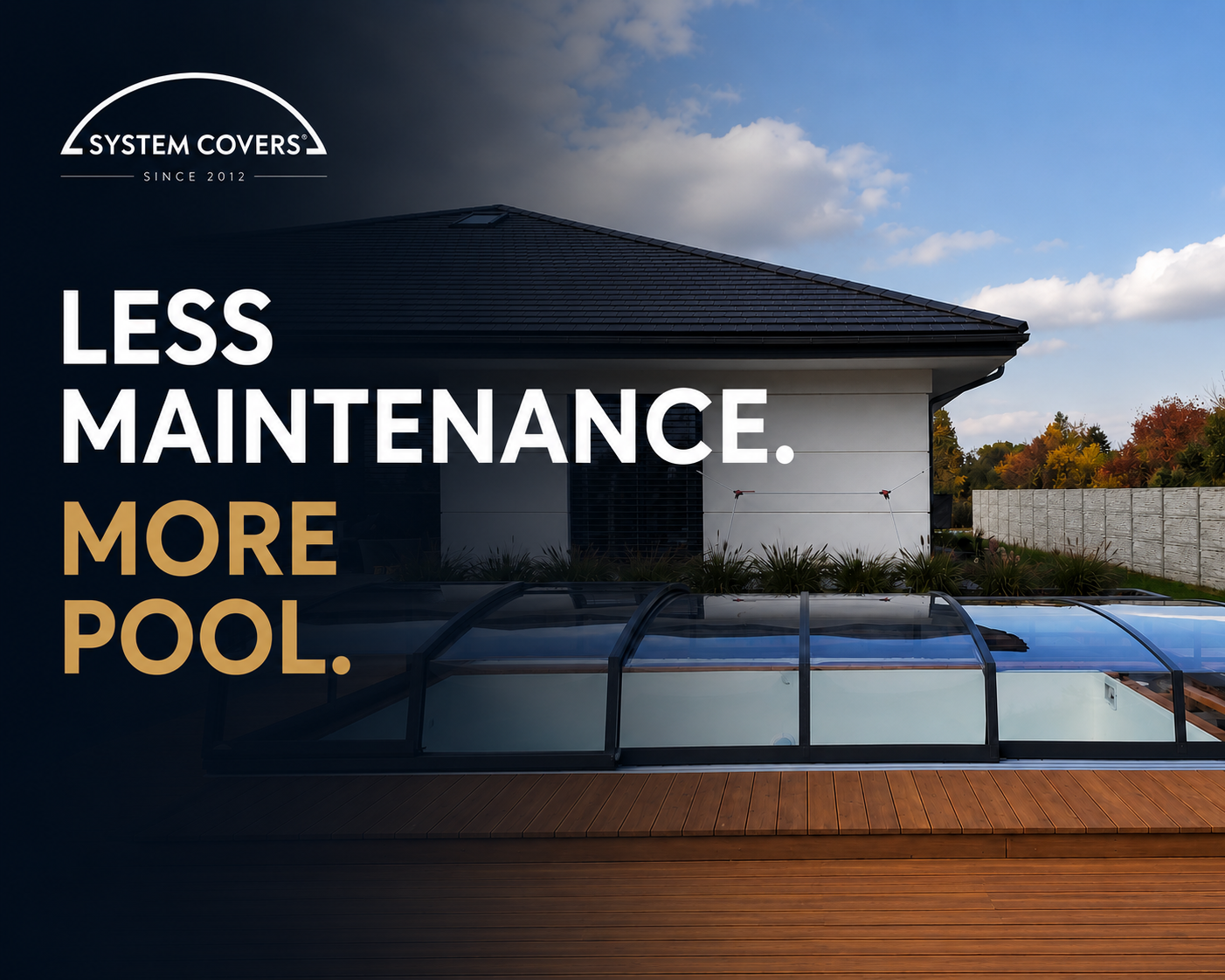
A pool enclosure does not eliminate pool chemicals — chlorine, pH regulators, and periodic algicide are still needed. But it dramatically reduces the demand for each of these substances, changing the maintenance rhythm from daily to weekly and allowing for significant savings in the annual chemical budget. The mechanism is simple: the enclosure cuts off four main sources of disruption to water chemistry.
What disrupts chemistry in an open pool
Before we describe what the enclosure reduces, it’s worth understanding what specifically consumes it. An open garden pool is constantly influenced by four external factors, each of which separately requires a response in the form of additional chemicals.
Organic matter
Leaves, needles, flower pollen, insects, and bird droppings entering the water. Each organic debris consumes chlorine (oxidation) and raises pH.
UV radiation
The sun breaks down free chlorine — on a hot day, a reduction in chlorine levels by half is not unusual if the pool does not have a UV stabilizer in the form of cyanuric acid or a physical cover.
Precipitation
Rain dilutes chemicals and changes the pH of the water — rainwater is naturally acidic. After significant rainfall, the pool requires rebalancing.
Water evaporation
On hot days, the water level can drop by several centimeters. Every refill from the hose means re-adjusting the chemistry — new water has no chlorine, stabilizer, or appropriate pH.
Reduction mechanism — what the enclosure really does
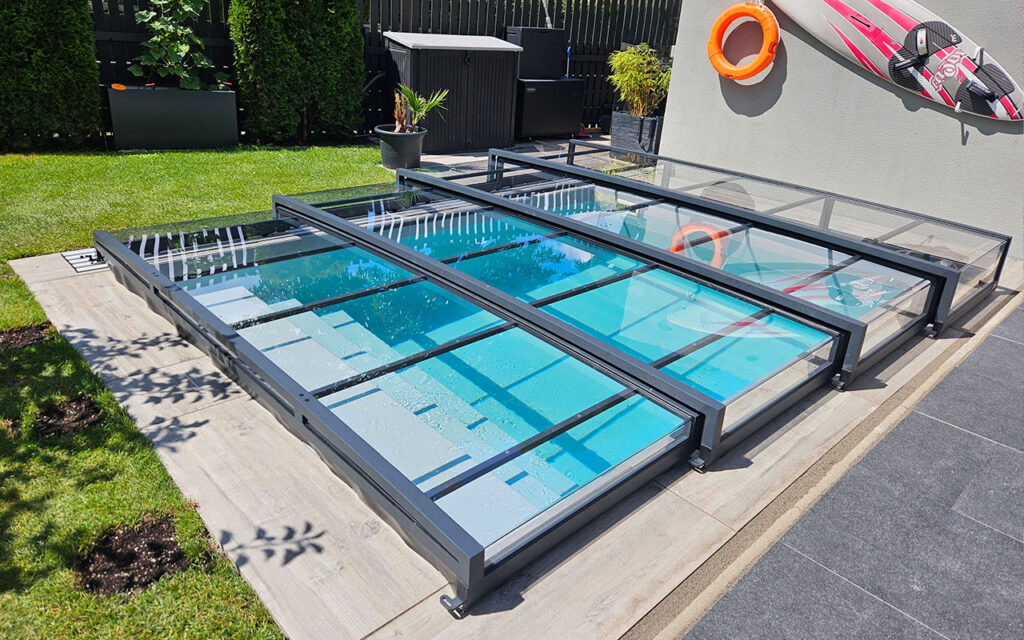
A pool enclosure is not a chemical device — it does not filter water, produce chlorine, or regulate pH. It acts solely as a physical barrier between the pool and the external environment. Nevertheless, it affects water chemistry in four ways, each corresponding to a different category of consumed substances.
Physical barrier against contaminants. Leaves, pollen, insects, and bird droppings do not enter the water. Less organic matter in the water means that chlorine is not consumed for their oxidation. This is the largest savings item — especially in spring (pollen) and autumn (leaves).
UV filter in the covering. The 3 mm solid polycarbonate used in System Covers enclosures has a double-sided UV filter. Ultraviolet radiation, which normally breaks down free chlorine in the water, is partially blocked by the panel. Chlorine lasts longer, and dosing is lower.
More stable water parameters. Under the cover, the pool is protected from rain (which dilutes chemicals and lowers pH) and the need for frequent topping up of fresh water due to evaporation. Additionally, the water does not cool down at night as rapidly as in an open pool. These three factors together result in less frequent pH adjustments — the main mechanism here is the reduction of rainfall and the addition of new water, with temperature being an additional factor.
Reduction of evaporation. Under the cover, water vapor does not escape freely into the atmosphere. The water level drops more slowly, and the addition of fresh water (from a hose, meaning without chemicals) is less frequent. Stable volume = stable concentrations of chemicals.
Categories of pool chemicals and how each one changes
Annual expenses on pool chemicals typically include five to six categories. Each reacts differently to the presence of a cover. Below is a breakdown showing where the savings are greatest and where they are minimal.
| Category | Without a cover | With a cover |
|---|---|---|
| Chlorine (disinfection) | High usage Frequent measurements, topping up every few days during the peak season. | Significant reduction Measurements once a week, less frequent topping up. |
| pH regulators | Average usage pH spikes after rainfall and heat. | Usually fewer adjustments No rain diluting, less fresh water added, more stable temperature. |
| Algaecides | Frequent dosing Pollen, dust, and warm water promote algae growth. | Usually less often Less organic matter and light limit algae growth, but the problem may return with poor chlorination. |
| Clarifiers / flocculants | After every cloudiness After rain, storms, or heavy pool activity. | Rarely Water remains clear without intervention. |
| Cyanuric acid (UV stabilizer) | Necessary Without a stabilizer, chlorine evaporates within hours. | Often can be limited Polycarbonate with UV filter reduces exposure to radiation, but frequent opening of the cover may still require a stabilizer. |
| Winterizing agent | Once per season Standard position at the end of the season. | Once per season No changes — winterizing must be done anyway. |
The biggest savings position is chlor and algicide.The second significant change can be the UV stabilizer — in many pools under the cover, the use of cyanuric acid can be limited, which is an additional benefit for some owners (high concentrations of cyanuric acid are undesirable). The decision depends on how often the cover remains open during use.
Weekly maintenance rhythm — without cover vs with cover
Savings in chemicals are most evident when comparing two parallel weeks of pool maintenance — one without a cover, the other under a cover. Below are two typical scenarios during the full season (July, sunny weather, family use).
| Activity | Without cover | With cover |
|---|---|---|
| Water test (chlorine, pH) | Several times a week | Once a week |
| Adding chlorine | Every few days | Once a week or less |
| pH adjustment | After adding chlorine and rainfall | Once a week or less |
| Algicide / algaecide | Regularly as a preventive measure | Only reactively, when a problem arises |
| Cleaning the skimmer | Daily during the peak season | Once a week |
| Vacuuming the bottom | Every few days | Once a week or less |
| Adding water | Often during heatwaves | Once every 1–2 weeks |
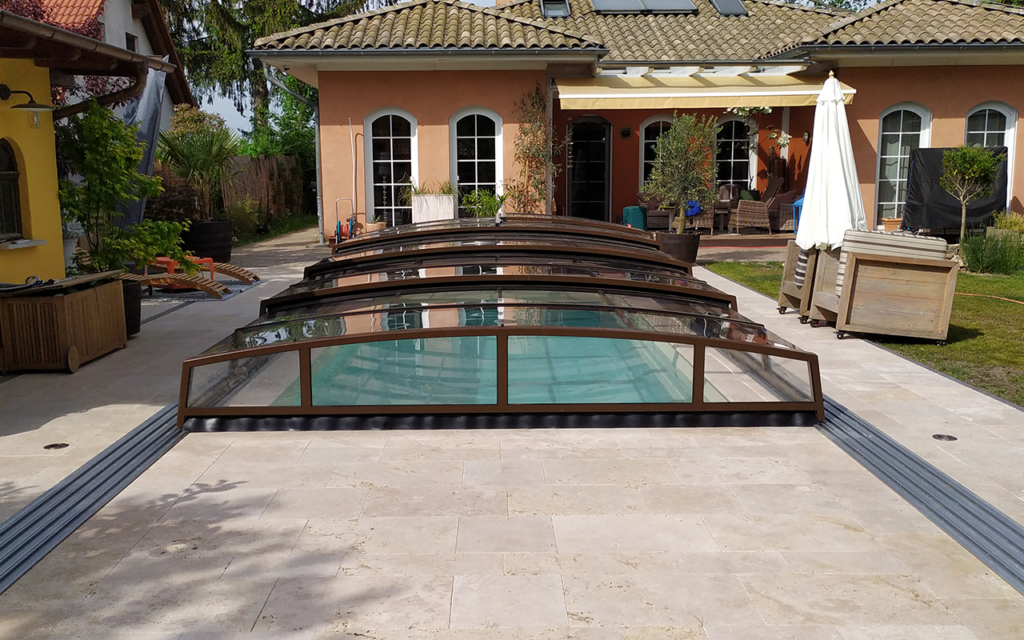
Overall maintenance of the pool under the cover is significantly shorter than that of an open pool, which requires several hours weekly plus daily skimming. This translates not only to chemical costs but also to the actual time of the owner.
Impact on water level and chemical balance
Often overlooked, but a very important mechanism: every addition of water to the pool requires rebalancing of chemicals. Fresh water from the hose lacks chlorine, stabilizer, has its own pH (usually 7.0–7.5 in Polish tap water, but varies) and its own carbonate hardness.
In an open pool, evaporation on a hot day can noticeably lower the water level — in a typical garden pool, this means adding hundreds of liters of fresh water every few days. Each such adjustment requires: a new pH measurement, pH adjustment, adding chlorine (diluted), and checking after 24 hours. Under the cover, evaporation is so reduced that adding water occurs once every 1–2 weeks, and in some configurations (walk-in, closed sides) even less frequently.
Choosing a model for the goal of „minimum chemicals”
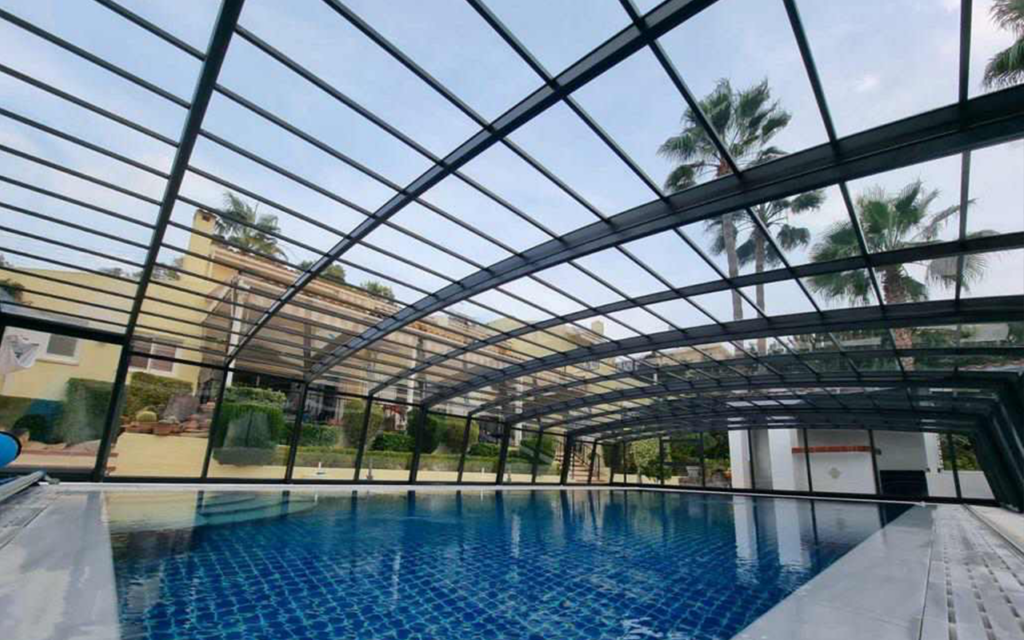
Every cover reduces chemical usage, but the degree depends on the design. The more enclosed the space above the pool, the fewer external disturbances reach the water. Below is the distribution of six System Covers models regarding the goal of „minimum chemical interventions.”
| Model | Degree of enclosure | Effect on chemicals |
|---|---|---|
| Santorini | Low 40–60 cm, tight above the surface | Very good protection against leaves, pollen, and insects. The water surface is just below the cover. |
| Bali | Low raised | Similar to Santorini, the air chamber additionally helps with evaporation. |
| Maledives | Medium, arched | Full air chamber over the water — minimum evaporation, maximum temperature stabilization. |
| Rodos | Medium, arched | Identical chemical protection as Maledives, additionally better snow resistance. |
| Dominicana | 60/80 cm, arched | Bestseller — a compromise between low and medium. Sufficient chamber for reducing evaporation. |
| Tenerife | Walk-in | Maximum environmental control — enclosed space, least disturbances from outside. |
For the purpose of „minimum chemicals” practically every model fulfills the task. The differences between models are more about usability (swimming, walking) and aesthetics than chemical efficiency itself. More about how the enclosure pays off in real use — through a significantly longer swimming season — can be found in the article on extending the swimming season.
Frequently Asked Questions (FAQ)
No. Every pool with a chlorine disinfection system still requires chlorine, regardless of the enclosure. The enclosure reduces consumption — chlorine lasts longer in the water (less UV radiation, less organic matter to oxidize), so dosing is lower and less frequent. But the disinfection system must operate the same way.
In most cases, yes — algae prevention becomes a reactive reserve, used only when an actual algae problem arises. Regular preventive dosing, which is standard in open pools, is not necessary in a pool under an enclosure.
Yes. Filtration time in the pool should be proportional to the water temperature — with warm water in the full season, a minimum of 8 hours a day. Under the enclosure, the lower threshold can be maintained because the filter does not have to deal with external dirt — standard circulation and disinfection are sufficient.
The winterizing agent itself — remains unchanged, you dose it the same as in an open pool. What changes is the spring uncovering of the pool: under the enclosure, there are no leaves, needles, branches, or dirt that fell into the water during winter. The first startup of filtration in spring takes hours, not days.
In many cases, its use can be limited, as solid polycarbonate 3 mm with a double-sided UV filter reduces the water’s exposure to ultraviolet radiation — chlorine is not broken down as aggressively. Complete elimination of the stabilizer may be possible in pools rarely opened during full sun; with frequent opening of the enclosure during midday, the stabilizer may still be needed in lower doses. The decision is best based on chlorine measurements in real usage conditions.
The specific percentage depends on many factors — type of enclosure, pool surroundings (whether there are trees, dust), intensity of use, disinfection system, climate. From our observations with clients: the reduction in chlorine consumption is most noticeable, algae prevention practically disappears from the budget, pH regulators are consumed less frequently. Overall, the annual chemical budget clearly decreases, but precise numbers depend on each client’s specific situation.
Do you want to lower your chemical bills and maintenance time for the pool?
The enclosure estimate takes up to 24 hours, is free of charge, and includes selecting a model based on your pool type, RAL color, and delivery to your home — with no hidden costs. We will help you choose a model tailored to your specific usage profile.