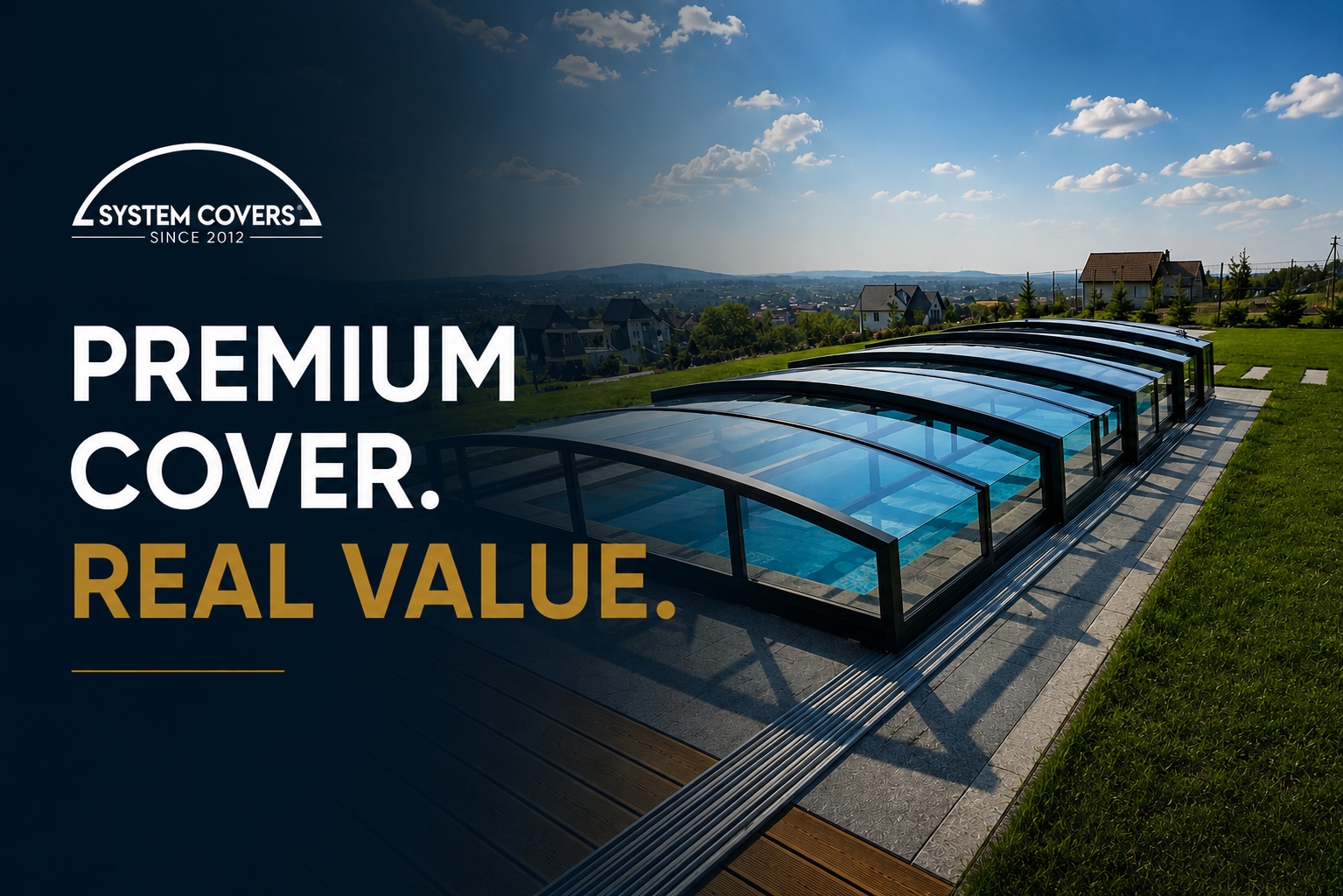
„I have an offer that’s half the price — what’s wrong with yours?” This question comes up in every second sales conversation. The answer is less dramatic than the client expects — there’s nothing „wrong” with either our offer or the cheaper one. They are simply different products, in different quality segments, with different long-term implications. In this article, we specifically break down the difference between premium and budget enclosures — and when each makes sense.
What does „premium” vs „budget” mean in pool enclosures?
Pool enclosures available on the Polish market can be divided into three price segments. The boundaries are not sharp, but typically the distribution looks like this:
Budget
Most often enclosures imported from distant production markets. Low catalog prices, but often without customization for specific pools, with limited technical documentation, and extra charges for non-standard sizes and colors.
Medium
Polish and European serial enclosures, produced to order in standard configurations. Better documentation, but extra charges often still apply for non-standard configurations.
Premium
Enclosures customized individually for the client’s specific pool, with complete production documentation, at one price without hidden costs. Manufacturers with a documented history and available spare parts in the long term.
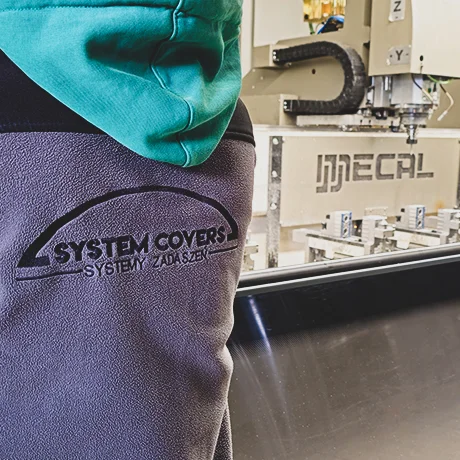
Each of these segments has its place — a client with a limited budget often consciously chooses a budget enclosure, accepting compromises. The problem arises when a budget enclosure is sold as „the same as premium, just cheaper” — which is rarely true at the construction level.
Five areas of technical difference
Each of the five categories below is an area where the client can ask the manufacturer a specific question — and compare answers from different offers.
| Area | Budget | Premium (e.g. SC) |
|---|---|---|
| Aluminum profiles | Weaker alloys, thinner walls Often without documentation of the alloy’s chemical composition | Aluminum 6060 40×50 standard, 80×50 reinforced for larger spans |
| Profile connections | Traditional welding + masking Visible seams covered with glued plastic caps. Adhesive deteriorates over the years. | Laser welding No visible joints or caps. No glued elements to degrade. |
| Polycarbonate | Hollow or thin solid Lower resistance to hail, shorter UV filter (often one-sided or absent) | Solid 3 mm with double-sided UV filter Resistant to hail and intense impacts. Optionally 4 mm. |
| Seals | Standard rubber Can harden, crack, crumble — first visible wear after a few seasons of frost | Durable EPDM Resistant to frost, UV, and pool chemicals. Material maintains tightness for many years. |
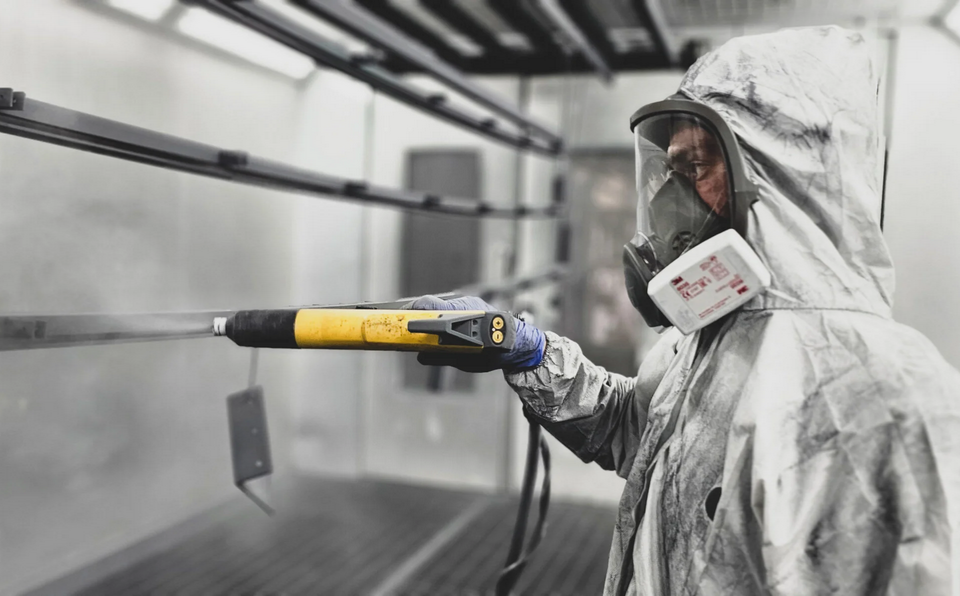
| Painting | External paint shop Often a narrow palette of standard colors, extra charge for custom RAL | In-house powder coating Any RAL color at standard price. Full control over shade and coating quality. |
Each of these areas may seem secondary on its own. Together they make up the difference that only becomes visible after several years of use — when the customer can no longer easily change the manufacturer.
More about one of the most important technical elements — laser welding vs traditional methods of profile joining — in a separate article.
Wojtek’s argument — „we show our connections, or rather their absence”
From our experience in conversations with clients comparing offers, one simple check resolves most technical doubts. The owner of System Covers puts it this way:
In practice, a client comparing two enclosures in person sees a clear difference:
- Budget enclosure — decorative ends on the corners of the segments (plastic caps), visible screws in the joints, sometimes visible welding marks under the edges. All these elements are points of potential failure — glue loosens, screws come loose, plastic crumbles under UV.
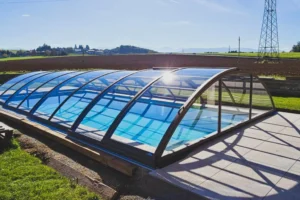
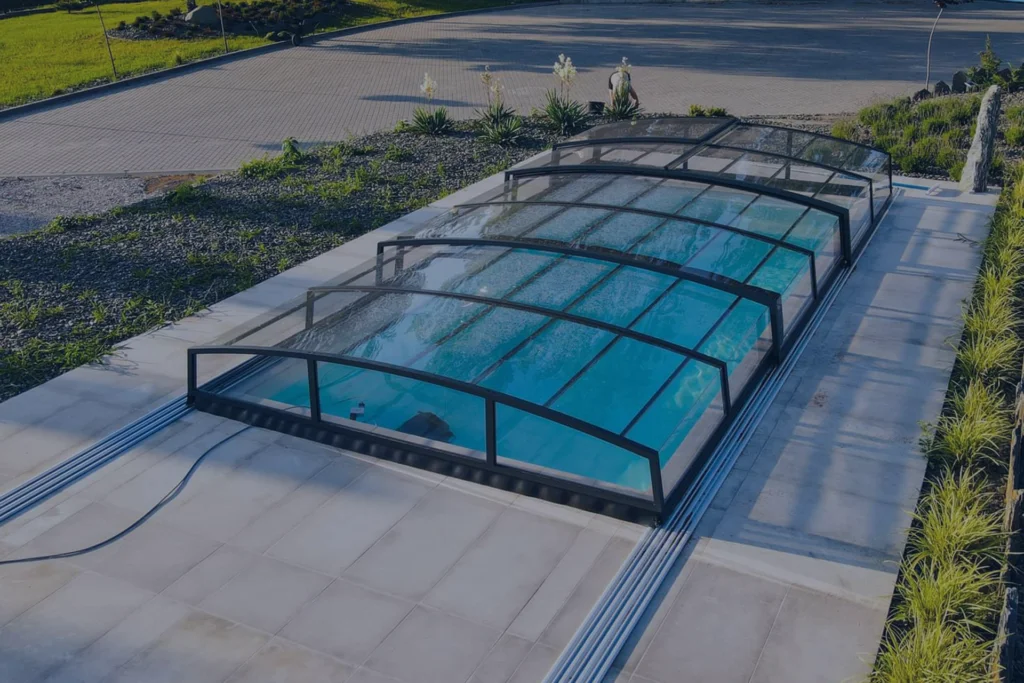
- Premium enclosure — aluminum profiles look like one piece of metal. The joints are laser welded on the outer edge and polished, without decorative ends. Structurally uniform, aesthetically consistent for many years.
This check requires one thing — viewing the finished enclosure in person (or in high-resolution photos from the manufacturer). It cannot be assessed from a brochure or rendered graphics.
Hidden costs of the budget enclosure
The catalog price of the budget enclosure is only part of the full bill. A complete comparison requires considering costs that only reveal themselves during use.
- Surcharges for custom configuration. The same 6×3 m pool can be quoted at the base price only with standard segments. Adapting to an unusual pool (with a ladder, inlet, handle on a specific side) often involves an additional charge — sometimes significant.
- Surcharge for RAL color. Standardly available in 2-3 colors (white, anthracite, brown). Any other RAL for the house facade — surcharge.
- Transport. In budget offers, transport is often quoted separately, depending on the distance and size of the enclosure. The full price including transport can be significantly higher than the catalog price.
- Lack of spare parts after 3-5 years. Budget manufacturers often change systems every 1-2 years. After a few years, a damaged lock or broken handle means searching for an alternative solution, as the original part may be unavailable.
- Lower value in case of potential property sale. A neglected or undocumented enclosure can realistically lower the value of the house offer. The breakdown of the topic in our article on the impact of a pool with an enclosure on property value.
Three scenarios — when premium makes sense
The decision „premium or budget” is not universal. Three specific scenarios where premium clearly pays off:
| Scenario | Why premium |
|---|---|
| A house with a pool in a long-term plan (10+ years) | A casing that lasts 15-20 years without the need for replacement parts is a different calculation than one that requires renovation every 5-7 years. Premium with available parts eliminates the risk of renovation. |
| A property with the potential for resale | A premium casing with production documentation and a factory appearance after years is a strong argument during the buyer’s due diligence. A budget casing that has been neglected over the years is the opposite. |
| Tourist/commercial rental | A casing that is heavily used (various tenants) loses its functional value more quickly. Premium with stronger materials withstands this without visible wear. |
When budget is sufficient
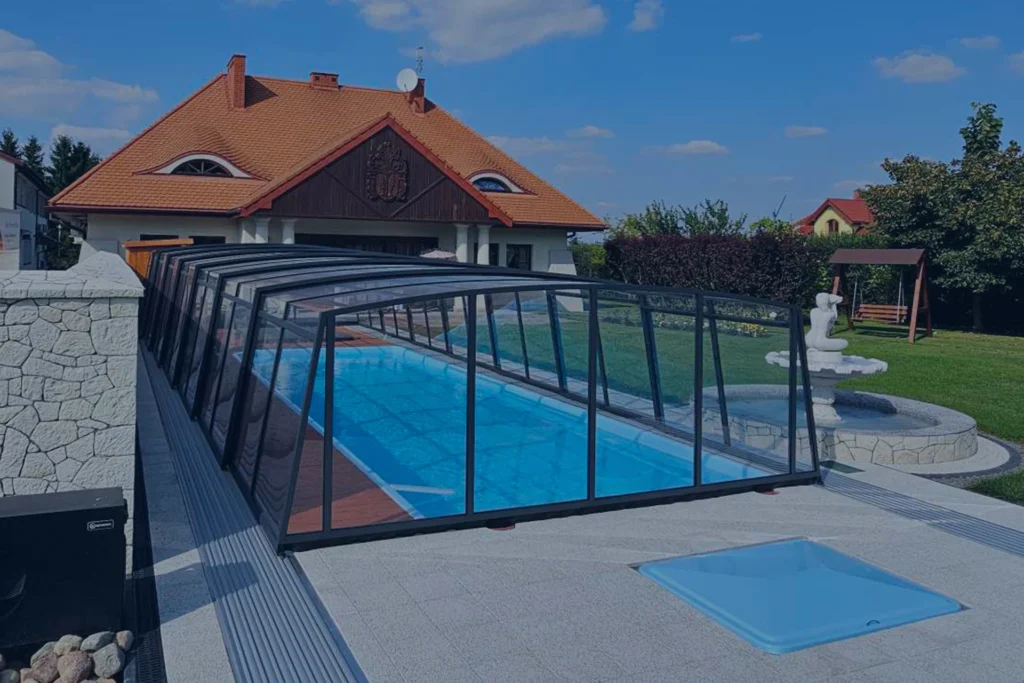
Honestly — a budget casing also makes sense in specific situations. Three examples where premium would be overpaying:
- A temporary pool in a rented house. If the pool owner knows they will move in 2-3 years and won’t take the casing with them, premium with a 15-year lifespan is simply economically irrational.
- A seasonal pool, used for 2-3 years. Some people buy a pool as an experiment — to see if they actually use it. A premium casing is an overkill if the pool turns out to be unnecessary after two seasons.
- A conscious decision of „cheaper now, then I’ll see”. A client with a limited budget who consciously chooses a budget casing with a plan to upgrade to premium in 5-7 years — this is also a rational strategy, provided they are aware of it.
In each of these scenarios, a budget casing serves a specific, limited need. The problem arises when a customer buys a budget casing expecting to get the same as premium for half the price. This rarely holds true in practice.
Frequently Asked Questions (FAQ)
From specific production decisions. The aluminum alloy used for profiles (6060 vs weaker alloys), the thickness of polycarbonate (3 mm solid vs thinner/structured), the joining technique (laser welding vs traditional welding + end masking), the type of seals (durable EPDM vs regular rubber), the location of painting (in-house painting vs external painter with extra charges for custom colors). Each of these decisions affects the cost — and the long-term durability of the structure.
It is possible for a cheaper casing to be „just cheaper” — without material compromises. But in practice, such an offer is rare. Most often, a price that is half means specific compromises in 1-2 areas out of the five we mentioned in section 2. Whether these compromises are acceptable to a given customer depends on the usage scenario.
Five specific questions to ask the manufacturer: 1) What aluminum alloy? (premium will answer „6060”). 2) What polycarbonate? (premium will answer „solid 3 mm with dual-sided UV”). 3) How are the profiles joined? (premium will answer „laser welding”). 4) Is any RAL color included in the price? (premium will answer „yes”). 5) Are spare parts available in 5+ years? (premium will answer „yes, the system has not changed for X years”). A lack of a specific answer to any of these questions is a warning sign.
Yes, this is a rational strategy if the budget is a real constraint. However, two things must be considered: first — a budget casing has no used value (selling after 5 years is usually a problem). Second — replacing the casing means additional installation, including potential adjustments to the rails and foundation. The total cost of „budget + replacement with premium” is typically higher than „premium right away.”
Yes, but not for aesthetic reasons. Laser welding provides a structurally uniform profile without weak points at the joints. Traditional welding requires decorative end masking, which can peel off over the years — then a gap appears inside. This is not just a cosmetic issue, but a place where moisture, dust, and insects can enter. Full breakdown — in our article on laser welding.
It means that the profiles, rails, seals, and locks used in the casing sold today will be the same as those from the casing sold 5 years ago. Practical consequence: spare parts are readily available, without the need to redesign them or look for substitutes. This is a key difference in long-term operation.
This is a real risk, especially with imported enclosures. The Polish and European markets are consolidating, and some smaller suppliers are disappearing or changing their offerings. A premium manufacturer with a documented production history and its own facility usually has greater stability. For an enclosure that is meant to last 15-20 years, this is a significant difference.
No. There are three situations where premium may be an overkill: a temporary pool in a rented house, an experimental pool used for 2-3 years, or a conscious strategy of „cheaper now, then I will replace it.” In these cases, a budget or mid-range enclosure may be a reasonable choice. The worst decision is to buy a budget option believing that you are getting the same as premium — this is rarely true.
Do you want to compare premium enclosure offers for your pool?
The quote is free and includes model selection based on garden type, RAL color for the house facade, number of segments, and transport to your home — all in one complete price. Full production documentation for comparison with other offers, with no extra charges for custom configurations.