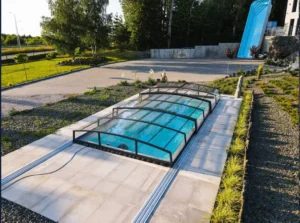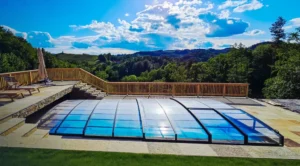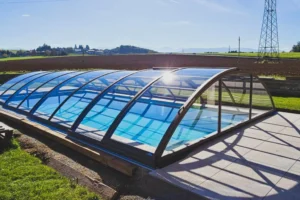
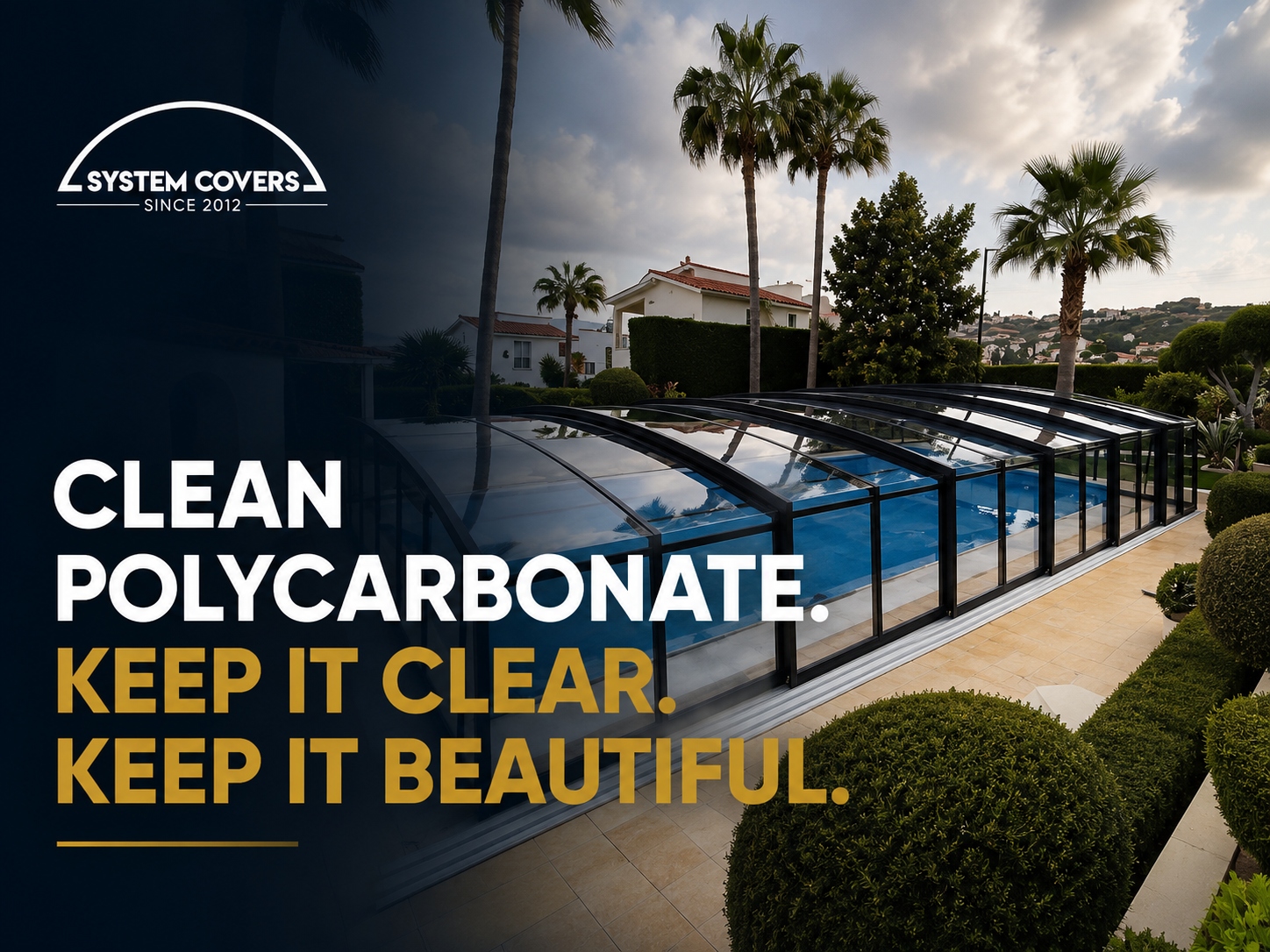
Polycarbonate in System Covers pool enclosures withstands hail impacts, frost, intense sun exposure, and pool chemicals for many years. One thing it can’t stand is aggressive cleaning agents and improper cleaning tools. One use of alcohol or a wire brush leaves marks that cannot be removed. The good news: proper maintenance is incredibly simple. The owner of System Covers sums it up in one sentence: „treat the cover like a car — gentle cleaning agents, avoid chemicals”.This article breaks down that sentence into specific rules, agents, and tools.
Why polycarbonate requires different maintenance than glass
3 mm solid polycarbonate with a double-sided UV filter used in our enclosures is structurally more durable than glass — resistant to impacts, hail, and wind. However, from a washing and maintenance perspective, it behaves completely differently. The three main differences:
Softer surface
Polycarbonate is easier to scratch than glass. Any hard brush, wire sponge, or sandpaper leaves permanent marks that cannot be polished out.
Chemical sensitivity
Acetone, alcohol, ammonia, benzene, strongly alkaline agents degrade the surface of polycarbonate. The effect: clouding, micro-cracks, loss of transparency.
UV filter on the surface
The double-sided UV filter is part of the coating. Aggressive agents can damage it — then the panel begins to yellow and become cloudy.
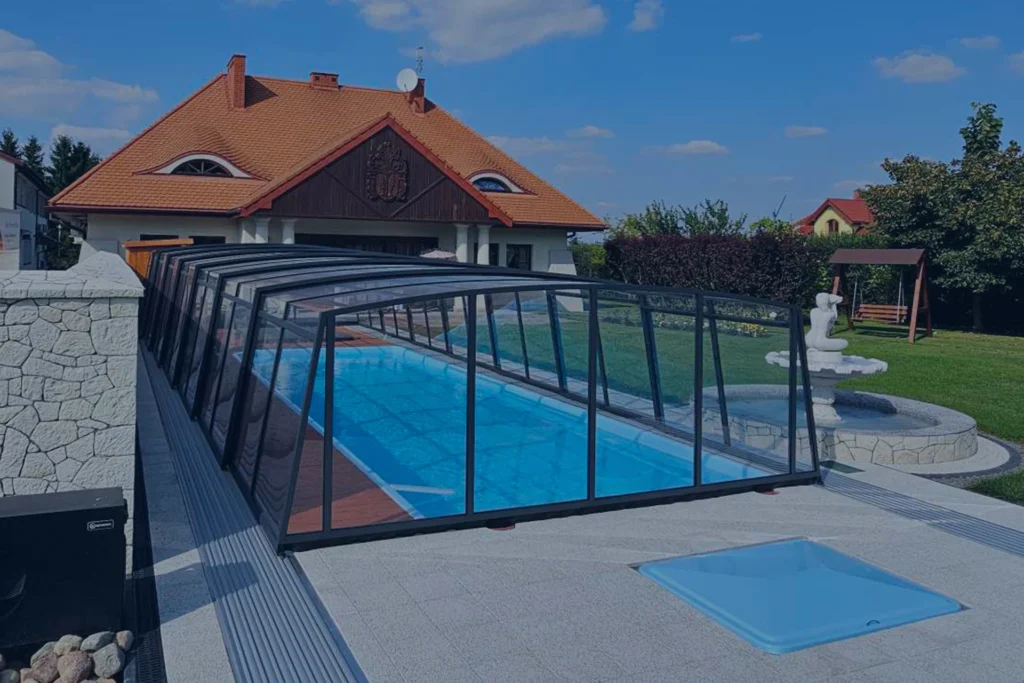
How often to clean — at least seasonally
There is no one-size-fits-all schedule. The frequency depends on the environment (trees, dust, construction nearby), intensity of use, and the season. Three levels in practice:
- Regularly during the season — rinsing the outer surface of the panels with a hose when a layer of dust, dirt, or needles is noticeable. A few minutes of work, once a week during the pollen season, less often at other times.
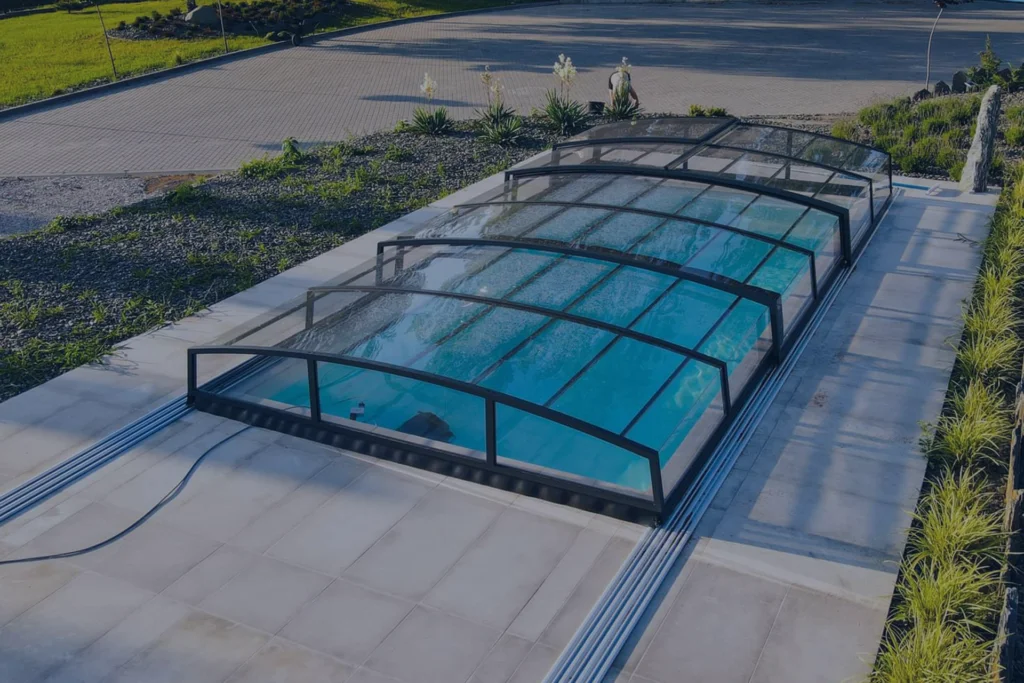
- Full cleaning in spring — opening the season. Washing the entire enclosure using a gentle detergent, soft sponge or microfiber, and lukewarm water. Removes accumulations from winter.
- Full cleaning in autumn — preparation for winter. A second full cleaning of the year plus a review of the mechanism (rollers, locks, handles).
In gardens with a lot of trees or near construction sites, the frequency of regular rinsing increases. In open spaces, a minimum of twice a year plus occasional rinsing is usually sufficient.
What to use — recommended agents and tools
| Category | Recommended | Why |
|---|---|---|
| Cleaning agent | Dishwashing liquid, liquid soap, demineralized water | Gentle, non-reactive with polycarbonate, leaves no residue |
| Water | Warm (not higher than about 40°C) | Too hot water can cause stress in the material, cold water dissolves dirt poorly |
| Abrasive material | Microfiber, soft sponge (like for washing a car), soft telescopic brush with long bristles | Do not scratch the surface, effectively collect water with detergent |
| Pressure washer | Only low power (max 100 bar), distance 1-1.5 m, wide nozzle | Allows for quick rinsing of large surfaces without mechanical contact |
| Finishing | Clean water for rinsing, optionally polishing with microfiber | Detergent residues leave streaks and reduce clarity |
What to absolutely NOT use
A list of agents and tools that guarantee damage to polycarbonate. Some may seem innocent — these are often agents that the customer already has in the garage or under the sink.
| DO NOT use | What will happen |
|---|---|
| Acetone, alcohol, ammonia, benzene organic solvents | They degrade the UV coating, causing dullness and micro-cracks, the panel becomes permanently cloudy |
| Strong alkaline agents type „for deep cleaning” | They react with the polycarbonate surface, destroy the UV filter, the panel starts to yellow |
| Wire brush, wire sponge | Permanent scratches that trap dirt, clarity decreases forever |
| Sandpaper, abrasive non-woven fabric | The same as a wire brush — permanent scratches, the material loses transparency |
| Pressure washer from close range high pressure, short distance | Can damage the coating, destroys EPDM seals at joints, local deformations |
| Washing in full sun | Water droplets act like lenses, causing permanent discoloration and streaks |
| Leather balm agents | Leave a greasy residue, collect dust, streaks do not wash off with water |
Step-by-step procedure — how to wash without scratching
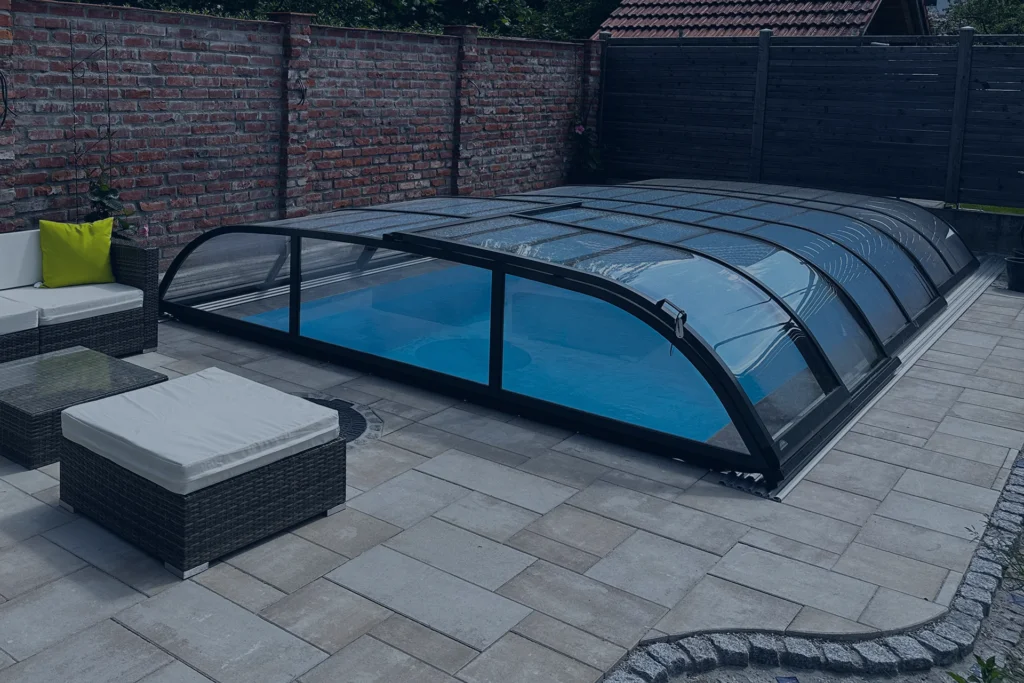
A full spring or autumn wash typically takes 30-60 minutes for a 6×3 m pool enclosure, depending on the model and level of dirt. Six steps of a safe procedure:
- Choose the right time. A cloudy day or early evening. Do not wash in full sun — droplets act like lenses, leaving permanent discoloration. Air temperature above 10°C, so the water dissolves dirt well and dries quickly.
- Pre-rinse with water. Rinse the entire outer surface of the panels with regular hose water — without detergent. Goal: to remove loose dirt (dust, pollen, small leaves), so as not to rub them into the surface during washing. Stream without pressure, from about a meter away.
- Prepare the cleaning solution. In a bucket, dilute a small amount of mild detergent (dish soap, liquid soap) in lukewarm water — the ratio as for washing dishes, slightly soapy water. A second bucket with plain water — for rinsing the cloth/sponge during work.
- Wash in sections, from top to bottom. Dip a soft sponge or microfiber cloth in the solution, gently wipe the surface in circular motions. Work in sections of about 1 m² — from the top of the roof down to the side panels. Rinse the sponge frequently in clean water to avoid rubbing dirt back in.
- Rinse thoroughly with clean water. A very important step. Residual detergent leaves streaks after drying and reduces the transparency of the panels. Rinse with a hose until the water running off the panels is clear. For arched models (Dominicana, Rodos, Maledives, Tenerife), water flows naturally along the curve.
- Optionally — wipe with a microfiber cloth. After thorough rinsing, you can gently wipe the surface dry with a microfiber cloth to speed up drying and eliminate micro streaks. An auxiliary step, not mandatory — in calm weather, the panels dry on their own in 15-30 minutes.
Maintenance of the mechanism — rails, rollers, locks
Washing the panels is one part of maintenance. The other is taking care of the mechanical elements — guide rollers, anodized rails, segment locks (butterflies), handles. These elements also have simple handling rules.
Rollers and mechanism
WD-40 or a similar product for operational elements. Spray once per season — in spring before opening or in autumn before winter. Goal: to facilitate the sliding of segments and protect against moisture.
Anodized rails
Rinse with water from a hose while washing the panels — remove sand, dust, small stones that could scratch the rails or block the rollers. They do not require lubrication.
Segment locks (butterflies)
Designed as a safety feature — they are meant to break under improper use, not the structure. Check before winter if all are secured. In case of damage, replacement is simple.
EPDM seals
A durable material, resistant to frost, UV, and pool chemicals. It does not require replacement or maintenance. Rinsing with water during panel washing is sufficient.
The complete maintenance procedure for the mechanism takes 5-10 minutes when done regularly. This is a very low workload compared to what it provides — several years of efficient use without service.
Seasonal routine — spring, summer, autumn, winter
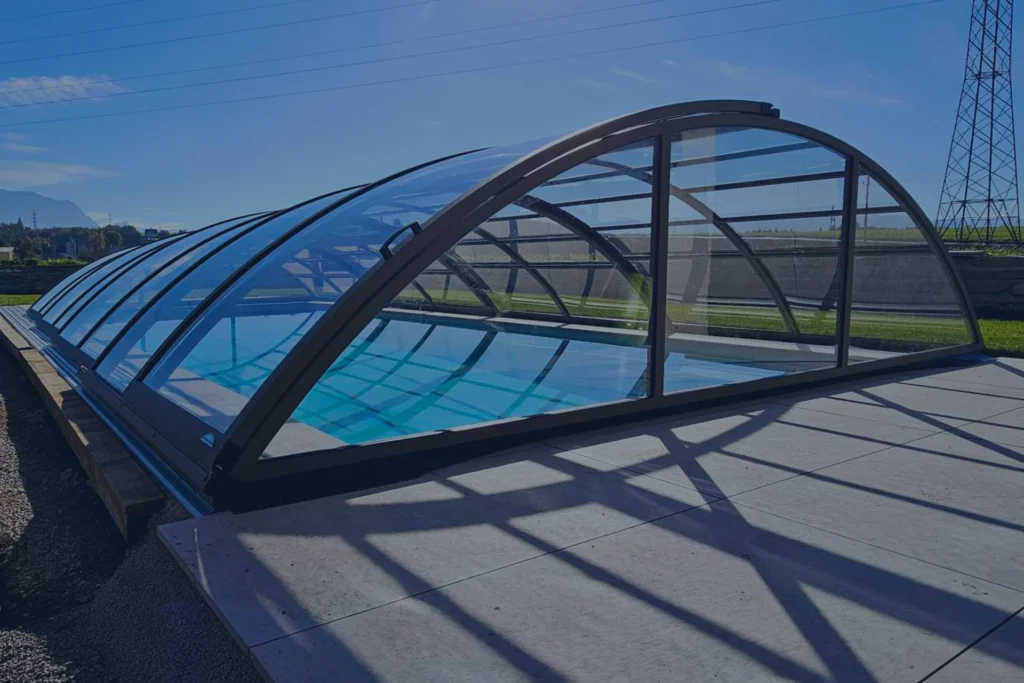
A complete maintenance schedule spread over four seasons. Most tasks involve ongoing observation and a few minutes of rinsing — full washing only twice a year.
| Season | What to do |
|---|---|
| Spring (March-May) | Full washing to open the season. Washing the panels, rinsing the rails, WD-40 on rollers and mechanism. Check all segment locks and handles. Open the enclosure for the first time slowly to verify the smoothness of the sliding. |
| Summer (June-August) | Ongoing rinsing. During the pollen season, rinse the panels with water when a yellow-green coating is visible. After each hailstorm, check for any damage (rarely occurs — 3 mm polycarbonate is hail-resistant). |
| Autumn (September-November) | Complete end-of-season cleaning. Cleaning the panels, possibly removing fallen leaves, another spray of WD-40 on the mechanism. Check the locks — ensure all segments are securely closed. No winter maintenance fluids are required. |
| Winter (December-February) | Practically nothing. Check once a month if the segment locks are secured (strong winds could try to open the segments). Shake off snow from low-profile panels (Santorini, Bali) if a thick layer accumulates. Arched models shed snow on their own. |
If the house is near trees, it’s worth doing the autumn cleaning after all the leaves have fallen — typically at the end of October. Cleaning earlier doesn’t make sense, as new leaves will continue to fall for several weeks.
Frequently Asked Questions (FAQ)
The simplest and safest option is dish soap diluted in lukewarm water. The ratio is like washing dishes — slightly soapy water. An alternative is liquid soap. There’s no need to buy specialized products — the owner of SC says: treat it like a car, meaning gently and without chemicals. What is safe for a car’s body is also safe for the polycarbonate cover.
Yes, but with two limitations: maximum pressure of 100 bar and a distance of at least 1-1.5 m from the surface. High pressure from close range can damage the UV coating, EPDM seals at the joints, and in extreme cases cause local deformations of the panel. Low power, a wide nozzle, and the appropriate distance — this works great for quickly rinsing large surfaces.
Yes, so don’t use it. Most popular window cleaning liquids contain ammonia or alcohol — both degrade the UV coating of polycarbonate. The effect doesn’t appear immediately, but after several uses, the panel starts to become cloudy or yellow. This change cannot be reversed. A safe alternative: water with dish soap.
Soak the area with water and a mild detergent for 5-10 minutes, then wipe with a microfiber cloth. In most cases, this is sufficient. Never try to „scrub” a tough stain with a stronger product or a rough sponge — this will guarantee scratches or damage to the coating. If the stain doesn’t come off after soaking, it’s better to leave it than to damage the panel by trying to force it off.
No. There are specialized products for polycarbonate available in hardware stores, but for typical dirt (dust, pollen, rain marks, snow), dish soap in lukewarm water works just as well. Specialized products may make sense for very large surfaces or heavily soiled installations — for a home pool cover, they are unnecessary.
WD-40 or a similar maintenance product — spray the rollers and locks once a season (in spring and autumn). Anodized tracks only need to be rinsed with water during panel cleaning to remove sand and dust. EPDM seals do not require maintenance or replacement — the material is durable, resistant to frost, UV, and pool chemicals.
3 mm solid polycarbonate with a double-sided UV filter maintains factory clarity for many years with proper care. The double-sided UV filter is key — it protects the material from solar degradation on both sides. From our experience, covers cleaned according to recommendations show no visible signs of wear after five or more years of use.
Minor scratches that do not affect clarity can be left. Serious mechanical damage (crack, hole, permanent cloudiness from improper cleaning) requires panel replacement. We perform replacements in our facility in Szydłowiec as a service, the panel comes back to us — the cost depends on the size. More frequently, the butterfly locks of the segments (designed as a safety feature) require replacement, not the panels.
The polycarbonate panels themselves do not react to salt. Powder-coated aluminum elements and stainless steel (on bearings) are also resistant. There may be a slight buildup on the outer part of the bearings — this does not affect the operation of the mechanism. A more common issue with saltwater pools is buildup on stainless steel elements due to excessive chemical dosing — in this case, it’s worth consulting the dosing with the chemical manufacturer. Panel maintenance — the same as with a chlorinated pool.
Complete protection mechanism of the cover against insects, leaves, and pollen we will discuss in a separate article.
Do you want a cover for your pool in your garden?
The quote is free and includes model selection, RAL color to match the house facade, number of segments, and delivery to your home — all for one complete price. Each cover is made in our facility in Szydłowiec, without subcontractors.