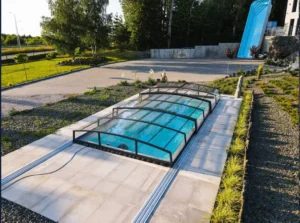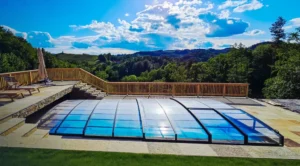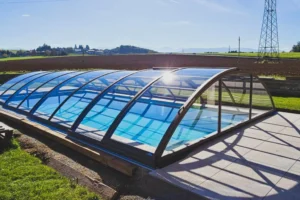
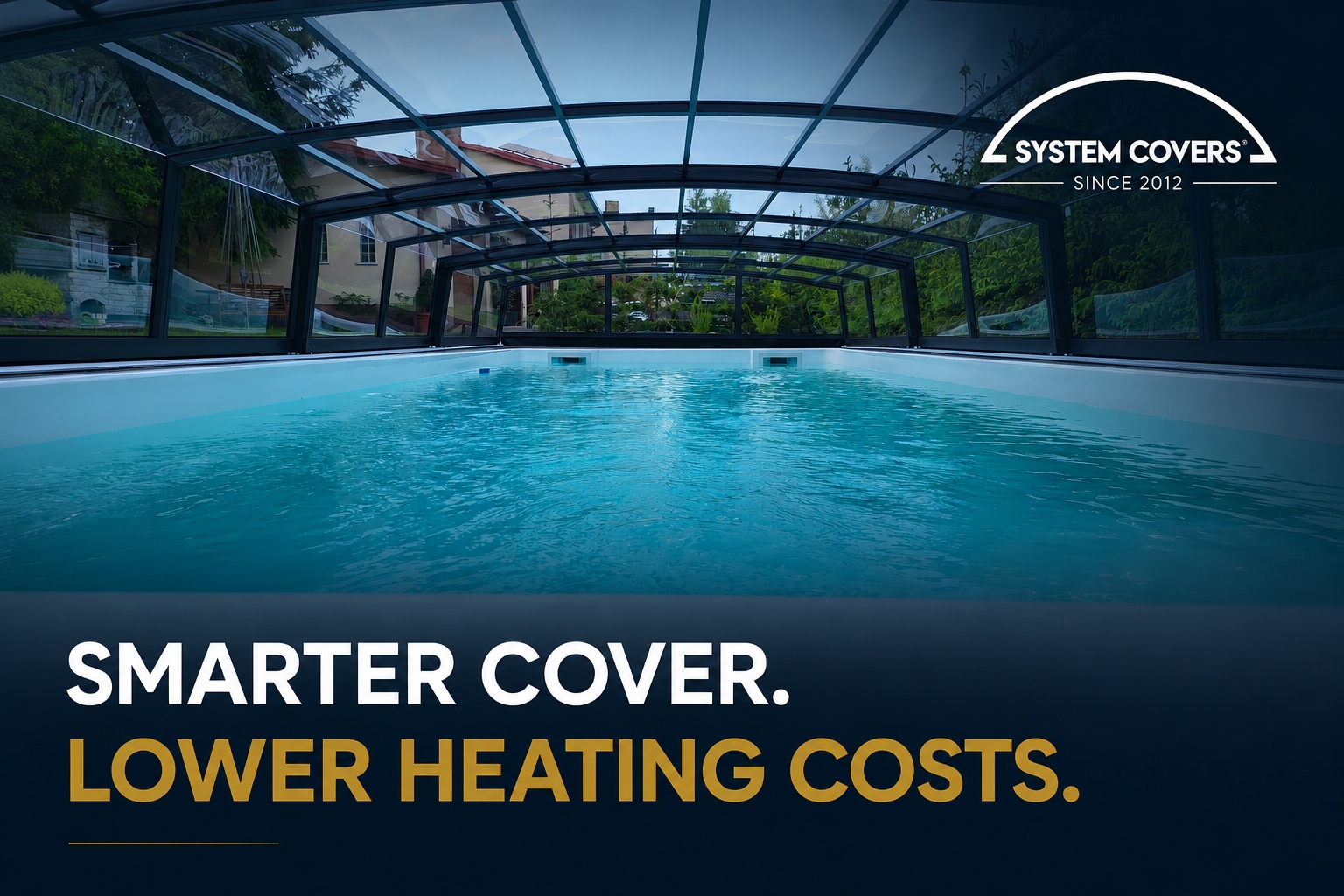
A customer with a pool heat pump often asks: does the enclosure change anything in the heating bills? The answer is „yes,” although the mechanism is different from what is commonly thought. A pool enclosure is not a heating device — it does not generate heat or warm the water. However, it reduces heat loss from the pool. There are four sources of heat loss, and each is reduced by the enclosure in a different way.
Four channels of heat loss from the pool
An open pool loses heat to the environment through four physical mechanisms simultaneously. Each operates independently and accounts for a different portion of energy loss.
1. Evaporation
Water continuously evaporates from the surface. Every liter of evaporated water carries away heat — this is the largest source of loss during the full season.
2. Radiation
The water surface emits infrared radiation towards the sky. This is particularly intense at night when the sky is cold.
3. Convection
Air flowing over the water surface carries away heat. Wind and convection enhance this effect.
4. Water topping
Fresh water from the hose is cold. Every topping requires reheating from the supply temperature to the pool temperature.
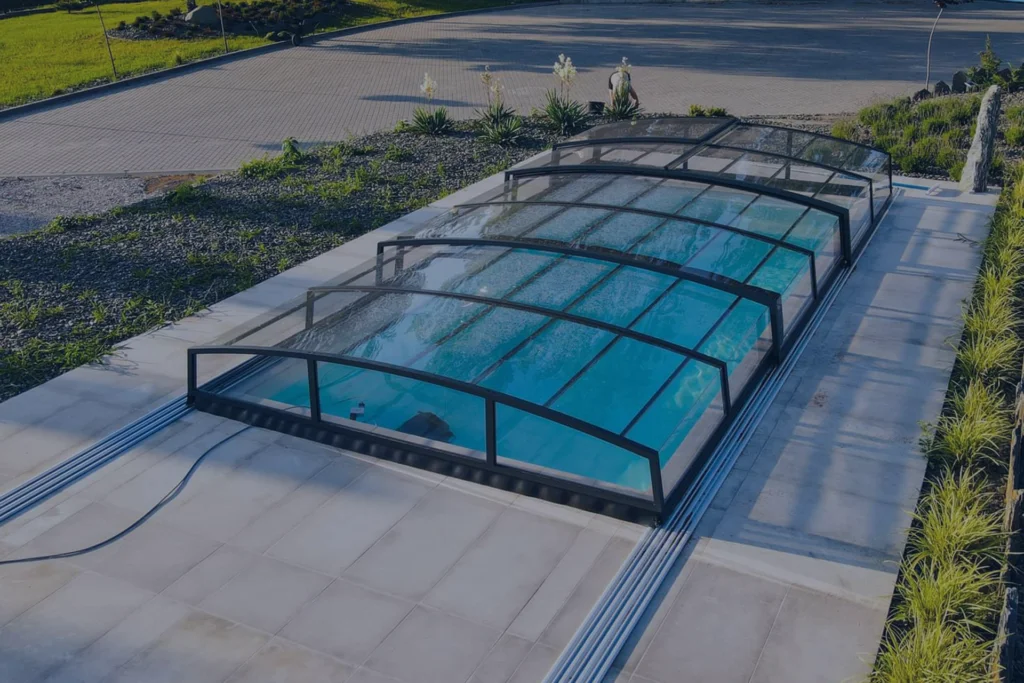
What exactly does the enclosure change
The pool enclosure is a physical barrier between the water surface and the environment. Each of the four channels of heat loss is reduced by the enclosure at a different level.
| Loss channel | Without the enclosure | Under the enclosure |
|---|---|---|
| Evaporation | Free all day long | Almost completely stopped — under the closed enclosure, the air quickly becomes saturated with water vapor and reaches equilibrium |
| Night radiation | Direct exchange with the cold sky | Limited — there is a layer of air under the polycarbonate between the water and the sky |
| Air convection | Wind freely flows over the surface | Stopped — air movement over the water practically does not occur |
| Water topping up | Regularly necessary due to evaporation | Occasional — minimal evaporation means minimal topping up |
The first three channels are reduced by the mere fact of the closed enclosure. The fourth (water topping up) is a consequence of the first — less evaporation means less topping up.
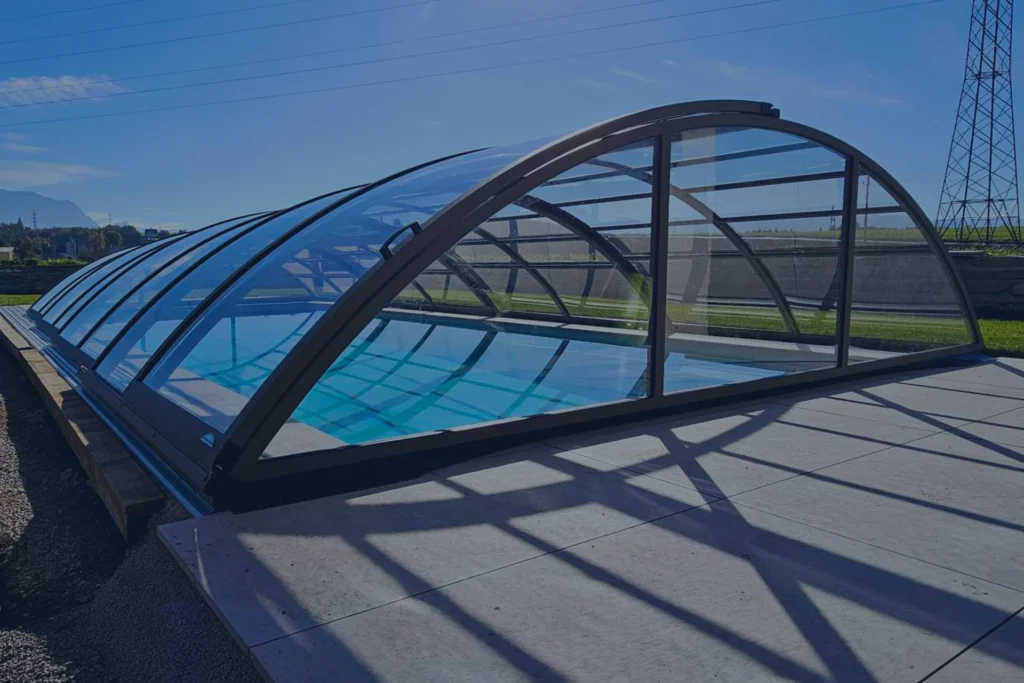
3 mm polycarbonate with double-sided UV — greenhouse effect
The material from which the enclosure is made is important for the thermal balance. In our offer, all models use solid 3 mm polycarbonate with a double-sided UV filter. An optional 4 mm version is available.
Polycarbonate is transparent to visible light — it allows sunlight to pass through, which heats the water. This works like a simple greenhouse effect: solar energy enters through the panels, the water absorbs it, and heats up.
Solid polycarbonate construction (as opposed to hollow — with air voids inside) provides uniform mechanical strength throughout its thickness. The material is resistant to hail and mechanical impacts.
Heat pump in a house with an enclosure — reduced load
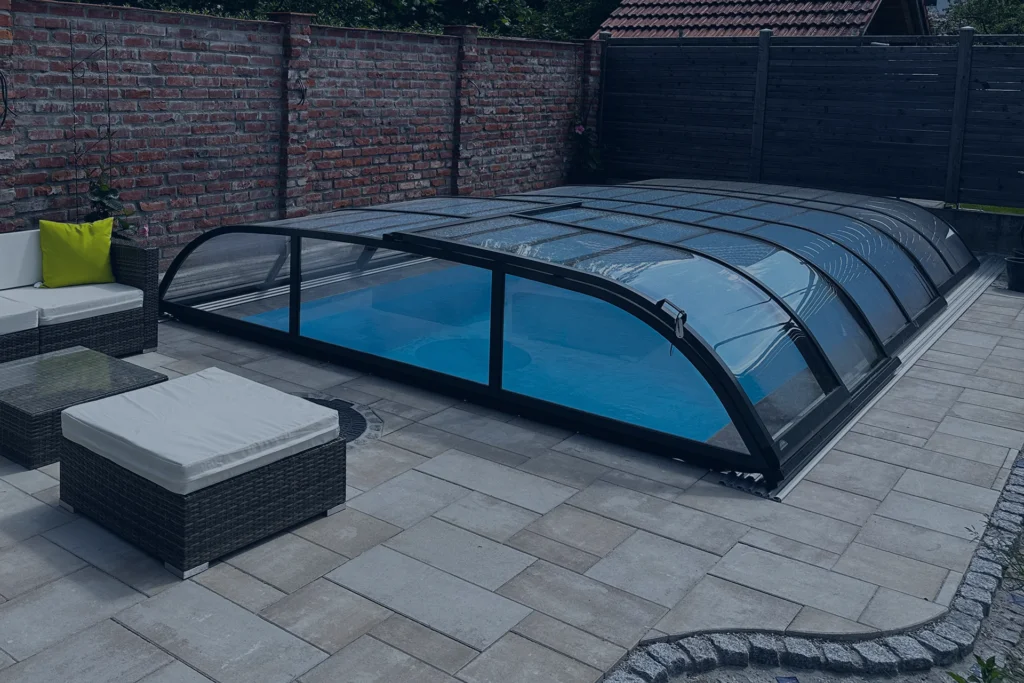
A customer who already has a heat pump installed for the pool often considers the enclosure as a complement to the system. The question naturally arises: since I have water heating, do I even need the enclosure?
From the perspective of energy balance, both elements work complementarily, not competitively.
- Heat pump provides heat to the pool water from the environment. It operates when the water temperature drops below the set value.
- Enclosure retains heat that would escape from the pool to the environment without it. It operates 24/7, regardless of the pump.
In a house with just a heat pump, the heating system must compensate for all losses from the four channels. In a house with an enclosure plus a heat pump, three of the four loss channels are practically stopped, and the fourth is significantly limited. The pump operates for a shorter time, in a less intense mode. The heating system maintains a more stable water temperature.
We do not provide specific numbers for energy savings. The actual effect depends on many variables: ambient temperature, frequency of pool use, wind intensity, type of pump, thermostat settings. Each case looks different.
When the cover makes the biggest difference
The effect of the cover on the thermal balance of the pool is not constant throughout the year. There are periods when the cover works most intensively — and periods when its impact is smaller.
| Period | Impact of the cover on the thermal balance |
|---|---|
| Transitional season (April-May, September-October) | Greatest A large temperature difference between day and night. Without the cover, heat gained during the day quickly escapes at night. |
| Full season (June-August) | Average High ambient temperature, water heats up from the sun. The cover mainly reduces evaporation. |
| Every night | Greatest Nighttime radiation has the strongest effect under cool, clear skies. The cover limits this. |
| Windy days | Significant Air convection over the open water surface cools the pool intensively. |
The cover provides the most benefit when the customer wants to extend the swimming season — which is precisely during transitional periods. In the full summer, the effect is less noticeable because the pool heats up from the sun anyway.
What the cover CANNOT replace
A pool cover is a barrier against heat loss. Three things that the cover will not do — even when perfectly closed:
- It will not generate heat. The cover does not have heating elements. If the water is cold at the beginning of the season (fresh fill, opening after winter), a heat source is needed to warm it up — heat pump, solar collector, or electric heater.
- It will not replace filtration and chemistry. The cover reduces mechanical contaminants (leaves, pollen) and partially chemical ones (less evaporation = more stable concentrations). It does not replace the filtration pump or pool chemicals. These operate independently.
- It will not heat the water at the very end of the autumn season. When the ambient temperature drops below a few degrees, the greenhouse effect during the day is not enough to maintain a comfortable swimming temperature. Active heating is needed here.
Frequently Asked Questions (FAQ)
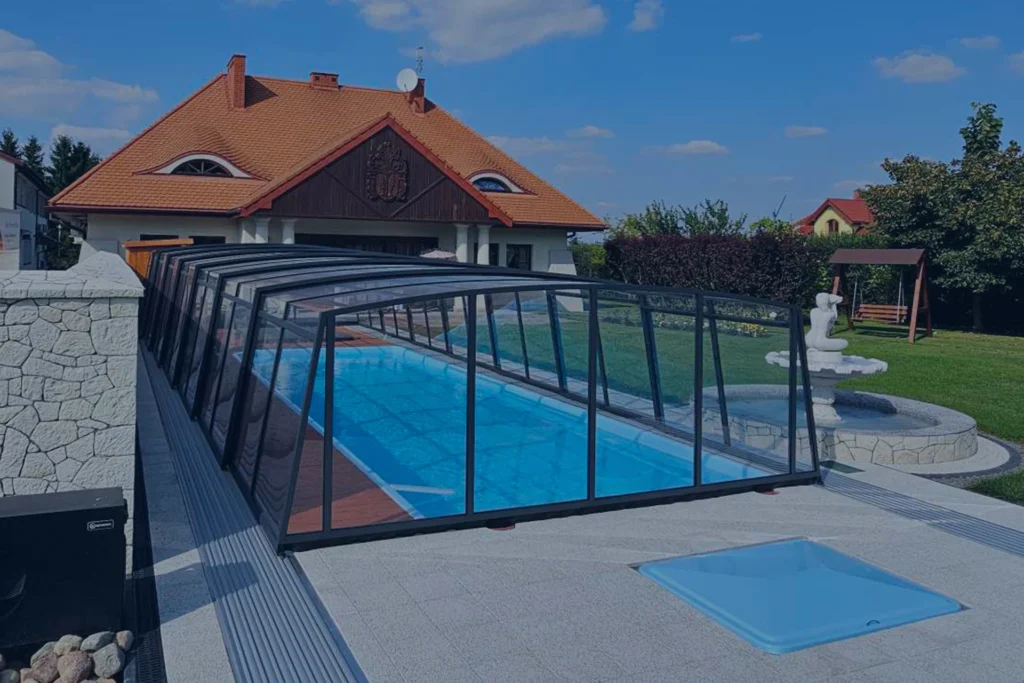
A heat pump and a cover are two different systems with different tasks. The pump provides heat to the water, while the cover retains heat that would escape without it. You can have just a pump, just a cover, or both. In a configuration with a cover, the pump operates less frequently because heat loss is reduced. The decision depends on priorities — comfort, frequency of use, length of the season.
We do not provide specific percentages or numbers for savings. The actual effect depends on many variables — ambient temperature, frequency of pool use, wind at the location, type and settings of the pump, insulation of the pool basin. Each installation behaves differently. However, the physical mechanism is the same: less heat loss means less work for any heating system, regardless of its type.
The cover itself utilizes the greenhouse effect — sunlight passes through the polycarbonate and heats the water. On sunny days, the water under the cover heats up faster than without it. In practice, customers who have a cover without additional heating report comfortable temperatures from spring to early autumn. In peak summer, the water can even be too warm. At the very beginning of the season (April) or at the very end (October) — depending on the weather — additional heating may be needed.
The mechanism for reducing heat loss is similar for all our models — they all use the same 3 mm polycarbonate with a double-sided UV filter and the same aluminum construction. The difference mainly lies in the volume of air under the cover. Higher models (Tenerife walk-in) have a larger volume of buffer air. Lower models (Santorini, Bali) have a smaller one. This affects how quickly the temperature changes under the cover. For a typical scenario, the choice of model depends on usage priorities (swimming, walking, aesthetics), not on heat loss.
Yes, although to a lesser extent than heat. A closed cover reduces precipitation (less dilution of chemicals by rain), evaporation (more stable concentrations of agents), pollen, and leaves (less organic matter to oxidize with chlorine). We do not provide specific numbers here either — the effect depends on the environment (trees around the pool, dust, frequency of use). However, the physical mechanism is the same as with heat — the barrier limits exchange with the environment.
The difference in material thickness mainly has structural significance — greater mechanical strength. From a thermal balance perspective, both materials behave similarly because the mechanism of the greenhouse effect (light transmission plus convection retention) does not significantly depend on panel thickness. We recommend 4 mm in specific situations — larger spans, locations with strong hail.
Yes. The cover is installed around the pool, on a hardened surface (concrete terrace, paving stones). The heat pump usually stands outside the pool perimeter — in the garden or near the building. Both elements do not interfere with each other installation-wise. If the pump requires wires or pipes running under the edge of the pool, we take this into account in the configuration of the cover’s guiding rails.
It depends on expectations regarding the length and intensity of the season. The cover alone allows for comfortable swimming in the warm months (June-August) and significantly extends the season into transitional periods (spring, autumn). For an early start to the season (April) or extending it to November, additional heating is necessary. Full comparison of models includes usage scenarios that can help in decision-making.
Do you want a quote for a pool cover based on your scenario?
The quote is free and includes model selection based on your pool type, RAL color, number of segments, and transport to your home — all in one price KPL. We will help you choose a configuration based on specific needs, including cooperation with an existing heat pump.