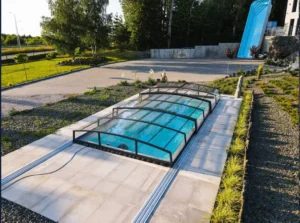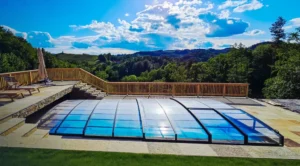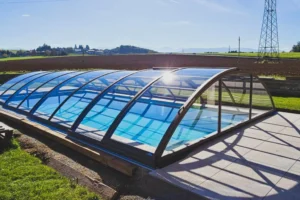
A pool cover installed together with the pool — in the same season, preferably in the same weeks — changes three things that are hard to recover later. It shortens the initial „learning” phase of the pool from twelve months to a few weeks. It extends the first swimming season from three months to six, often up to seven. And it saves real money right from the first chemical bill. An investment that pays off in the first year.
What happens to the pool without a cover in the first months
The first weeks after filling the pool is a phase where the owner learns to maintain the water — testing chlorine, checking pH, balancing hardness, observing how filtration reacts. An open pool during this period introduces additional variables: leaves from nearby trees, pollen in spring, insects, construction dust if the garden is still under finishing, rain that dilutes chemicals, sun that accelerates water evaporation and evaporates chlorine.
Each of these variables alone is not a problem. Together, they mean that the first season is a continuous struggle to regain water balance — adding chemicals, cleaning the skimmer several times a week, vacuuming the bottom, adjusting filtration. A cover does not eliminate these tasks, but it reduces most sources of contamination: leaves, pollen, insects, and dust do not enter the water. Less evaporation means a more stable concentration of chemicals and less water addition.
The first winter — often the most costly moment
The second critical point is the transition from summer to winter. A fresh pool, meaning a tank that has just been filled, finished, and connected to filtration — enters its first winter most susceptible to mechanical damage. The water surface freezes, branches fall, snow accumulates, ice damages the pool liner at the edges. A classic Polish winter means that an open pool requires thorough winterization: lowering the water to a certain level, adding winterizing chemicals, securing the skimmer, stretching a winter cover, regular checks to see if the cover has sagged from the snow.
A cover does not replace the winterization process — winterizing chemicals still need to be applied — but it eliminates most mechanical threats. The water surface under the cover is not exposed to direct snowfall and ice. The arched structure handles snow loads better than flat structures, reducing the risk of sagging the winter cover and damaging the pool edges from the weight of the precipitation. In spring, uncovering the pool is a matter of a few hours of work, not a weekend of cleaning the garden from leaf debris and repairing cracked elements.

Extending the first swimming season — from 3 to 6-7 months
The standard swimming season in Polish climatic conditions usually lasts from the end of June to the end of August — three months, with only July and August being fully usable. Without a cover, the garden pool is practically unused for the rest of the year.
A pool cover, regardless of type, utilizes a simple greenhouse effect mechanism: polycarbonate panels allow sunlight to pass through while limiting heat escape from the water surface. The effect is most visible in spring and autumn when the temperature difference between day and night is greatest. In practice, this means that a pool under a cover is ready for use as early as April (with appropriate weather and heating the water with a heat pump or solar), and the season ends only in October or November. We have described the exact mechanics of extending the swimming season step by step in the guide on how to extend the season from 3 to 9 months..
Without enclosure
Season: ~3 months
July, August, part of June and September — depending on the weather of the given year.
With low enclosure
Season: 5-6 months
May — September steadily. Swimming under the cover in this range is not comfortable.
With medium/high enclosure
Season: 6-7 months
April/May — October/November. Swimming under the closure is comfortable.
Economics of 5 years — with enclosure immediately vs after a year
The financial argument is often decisive in the decision of „now or later”. A customer who has just invested in the pool naturally looks for places where they can postpone another serious decision. The pool enclosure — starting from around 15,000 PLN for the smallest configurations (2 segments) and reaching around 30,000 PLN for a standard 6 m pool (3 segments) — can be that expense that is easily pushed „to next spring”. We discuss the financial arguments for and against the enclosure in a separate article: is the cover actually more expensive than the pool.
The problem with this approach is that the savings from the enclosure do not accumulate retroactively. Every month of the first season without an enclosure incurs specific expenses that would not exist with an enclosure:
- Pool chemicals — without an enclosure, the pool requires much more frequent additions of chlorine, algae inhibitors, and pH regulators, as pollen, leaves, and dust constantly disturb the water balance
- Water replenishment — evaporation is the biggest hidden cost of an open pool on sunny days, where the level can drop by several centimeters a day
- Winterizing and uncovering in spring — without an enclosure, winterizing requires a tarp, time, and monitoring; in spring, there is work involved in cleaning the pool from leaves and debris
- Personal time — often overlooked in calculations, but a real cost: without an enclosure, the pool requires 2-3 hours per week, with an enclosure less
An enclosure purchased in the first year saves all these costs from day one. Purchased after a year — it saves them only from the second year, and the first twelve months cannot be recovered.
Aesthetics and integration with the garden — easier the first time
An often overlooked but important design argument: a garden designed from the start with the enclosure in mind looks different than a garden to which we add the enclosure „after the fact”. The first version allows for choosing the color of the profiles (RAL palette included), designing paths so that the enclosure rails do not interfere with the layout of the terrace slabs, and positioning outdoor lighting so that it does not shine directly on the polycarbonate.
A customer who adds an enclosure after a year often has to accept three compromises: the rails do not fit perfectly with the terrace layout, garden lighting needs to be reconsidered, and the vegetation that grew next to the pool for a year sometimes interferes with the newly installed structure of the cover. None of these compromises is a tragedy, but all together are the reason why a customer sometimes regrets not deciding right away.
Logistics — when to order the enclosure when building the pool
The best order for someone building a pool and enclosure in the same season is as follows:
- Design the pool with an awareness of the dimensions of the enclosure. The edge of the pool is not the edge of the cover — the rails usually run 10-15 cm from the edge of the pool basin, so the terrace should allow for additional space for the guides.
- Order the cover 4-6 weeks in advance of the planned completion of the pool construction. Implementation during the season (April-July) takes 4-8 weeks; off-season (October-February) 1-4 weeks. The earlier you order, the lower the risk that the cover won’t be ready for the first season.
- Coordinate the installation of the cover with the installation of the terrace. Ideally, the terrace around the pool should be laid before the installation of the cover rails — this provides a level surface and allows for precise marking of the guide lines.
- The installation of the cover itself takes about 6 hours with two people. Most of our customers do it themselves according to the instructions — it does not require specialized tools or authorized service.
Choosing a model for the first season scenario
Six models from System Covers cater to different usage scenarios. The choice of model depends on what you want to achieve in the first season:
| Model | Height | First season — best fit |
|---|---|---|
| Santorini | 40-60 cm | A fresh pool as the focal point of the garden, a small plot, minimal bulk, water protection, and aesthetics |
| Bali | low/transitional | You want to swim in the first season, but you don’t want a large bulk in the garden — a compromise between low and medium |
| Maledives | medium, arched | The cheapest option in the medium range — when the budget after building the pool is tight, but you want to swim under a cover |
| Rodos | medium, arched | Regions with heavy snowfall — the most resistant structure to snow loads in the offer |
| Dominicana | 60/80 cm | Bestseller — an undecided customer who wants the option to swim while not wanting a large structure |
| Tenerife | walk-in | A large plot, pool as part of a family gathering area — full freedom to walk upright under the cover |
All six models are made of aluminium 6060, laser-welded profiles, and a cover made of solid polycarbonate 3 mm with a double-sided UV filter. Any color from the RAL palette is included in the price. Delivery: 1-4 weeks off-season, 4-8 weeks during peak season.
Frequently Asked Questions (FAQ)
Better to order it together with the pool. The most common scenario: a customer who postpones the decision returns after the first season with a ready decision to purchase — with the difference that the first twelve months were spent with an open pool, requiring more work and higher chemical costs. The decision is the same, made a year later and without the benefits of the first season.
Yes. The cover protects the pool from direct exposure to snow and rain, falling leaves and branches, and the arched structure better handles snow loads than flat structures. The pool still requires winterizing (winterizing agent, lowering the water to a certain level), but preparation and spring uncovering take dramatically less time.
No. A professionally made garden pool without a cover will easily survive the first year and beyond. The argument for a cover does not immediately concern the risk of pool damage, but rather the quality of the first season, chemical costs, the length of the swimming season, and maintenance comfort.
The installation itself is the same — about 6 hours with two people. Logistically, it is easier to plan the layout of the terrace and paths with the cover rails in mind from the beginning than to modify the garden layout after a year. However, there is no structural difference.
Off-season (October — February), fulfillment usually takes 1-4 weeks. During peak season (April — July), it takes 4-8 weeks. If you are building a pool for this season, it is best to order the cover 4-6 weeks in advance of the planned completion of the pool construction.
No. A sliding structure is not considered a building object under construction law — it does not require a permit or notification. This applies to all types of covers: low, medium, and high (walk-in).
2 years on the entire structure and cover. After the warranty period, all original parts (seals, wheels, guides, handles) are readily available directly from the manufacturer — the construction system has not changed over the years of production, so even after five or ten years, you can replace parts without any problem.
Are you planning a pool for this season? Order the cover together with the pool.
The quote takes up to 24 hours, is free, and includes model selection, RAL color, and delivery to your home — with no hidden costs. We will help you match the model to the dimensions of the pool, usage scenario, and completion date of the pool construction.