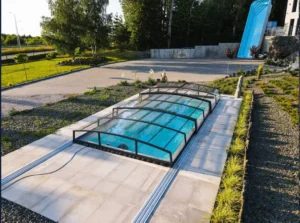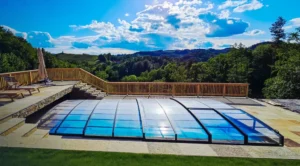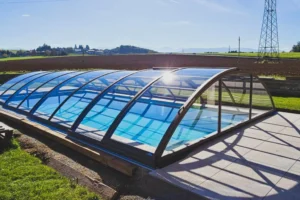
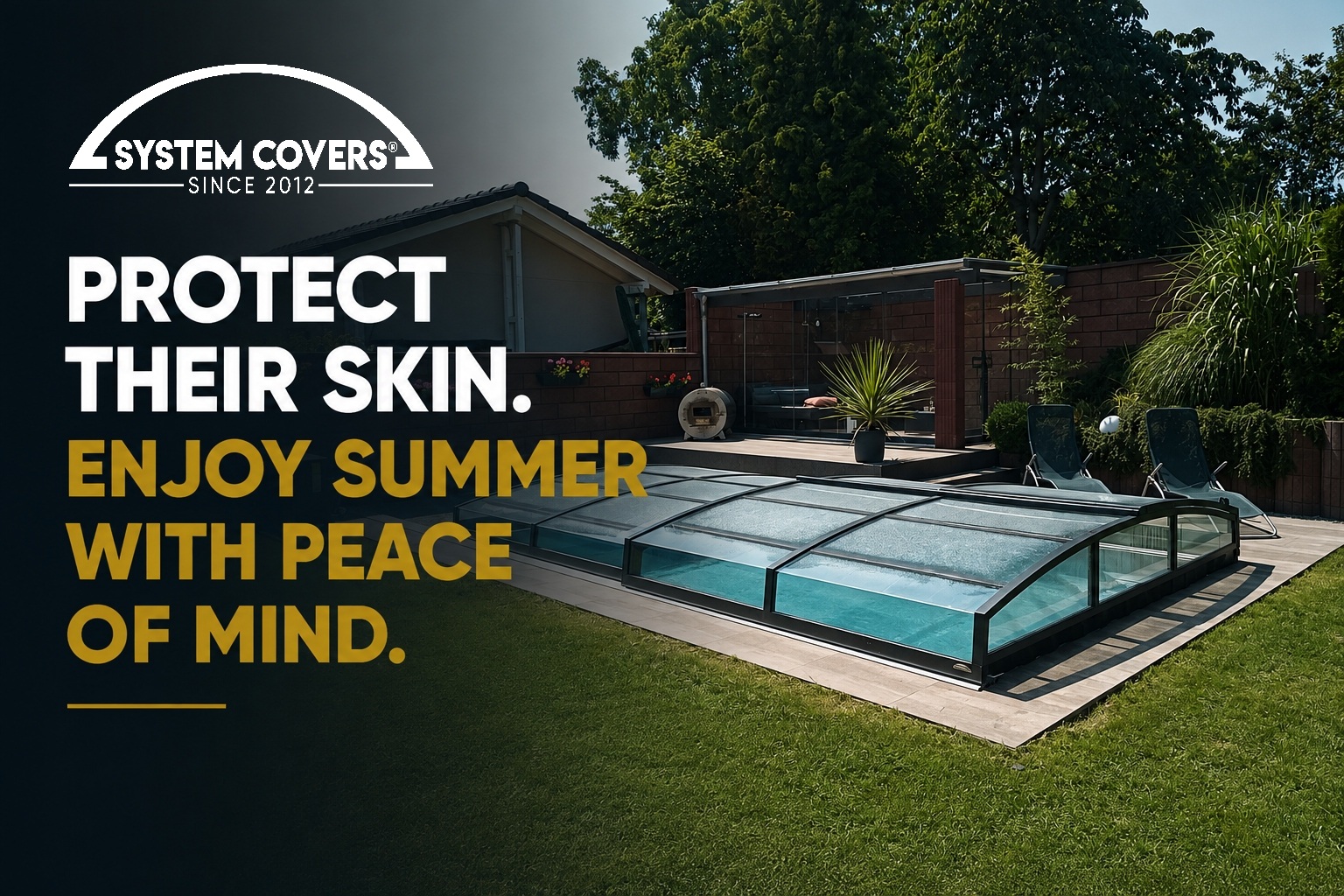
A child’s skin is significantly more sensitive to UV radiation than an adult’s skin. During summer water and sun activities, UV exposure accumulates quickly, and repeated exposures without protection in childhood are a significant risk factor for later skin changes. A pool enclosure made of solid polycarbonate with UV filter does not replace sunscreen but creates an additional layer of shading — particularly important during peak sunlight hours.
Child’s skin and UV radiation — facts
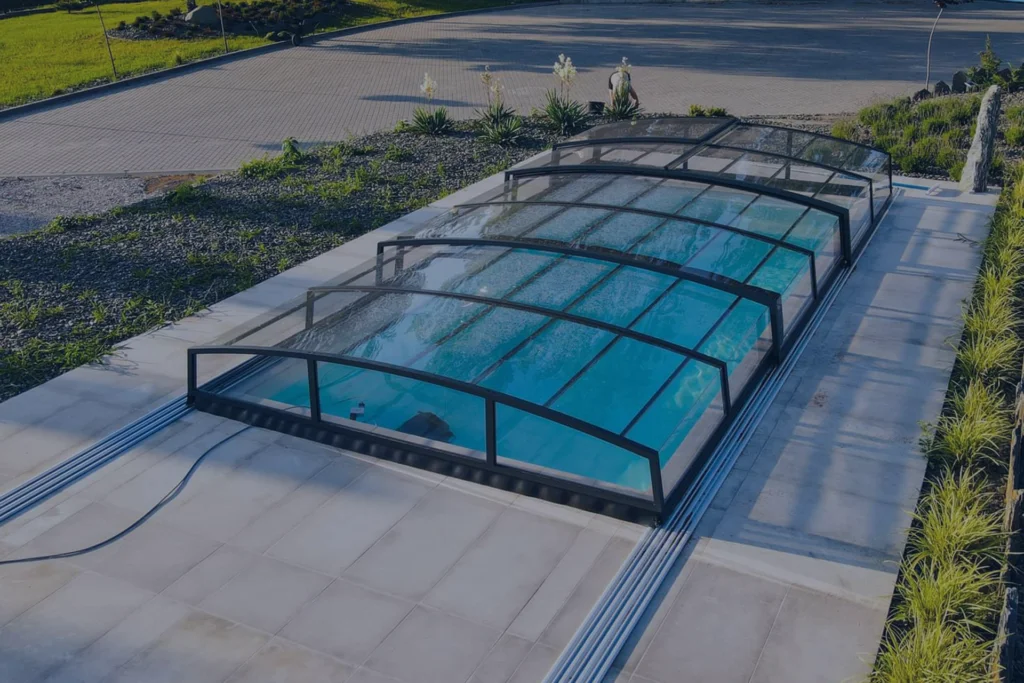
As indicated by the Emolium portal (according to PTD recommendations): an infant’s and small child’s skin is significantly thinner than that of an adult, has a more permeable stratum corneum and weaker defense mechanisms against UV.
Specific medical recommendations from dermatological studies:
- American Academy of Dermatology (AAD): children under 6 months should NOT be exposed to direct sunlight. Older children — SPF minimum 30 (according to MP.pl).
- PTD recommendations (Termedia 2018): in spring and summer SPF ≥ 30, autumn-winter ≥ 15. Protection is especially important for children up to 14 years old.
- Kosmopedia 2025: SPF 50+ blocks about 98% of UVB. No product provides 100% protection.
Peak UV hours and the pool — why it matters
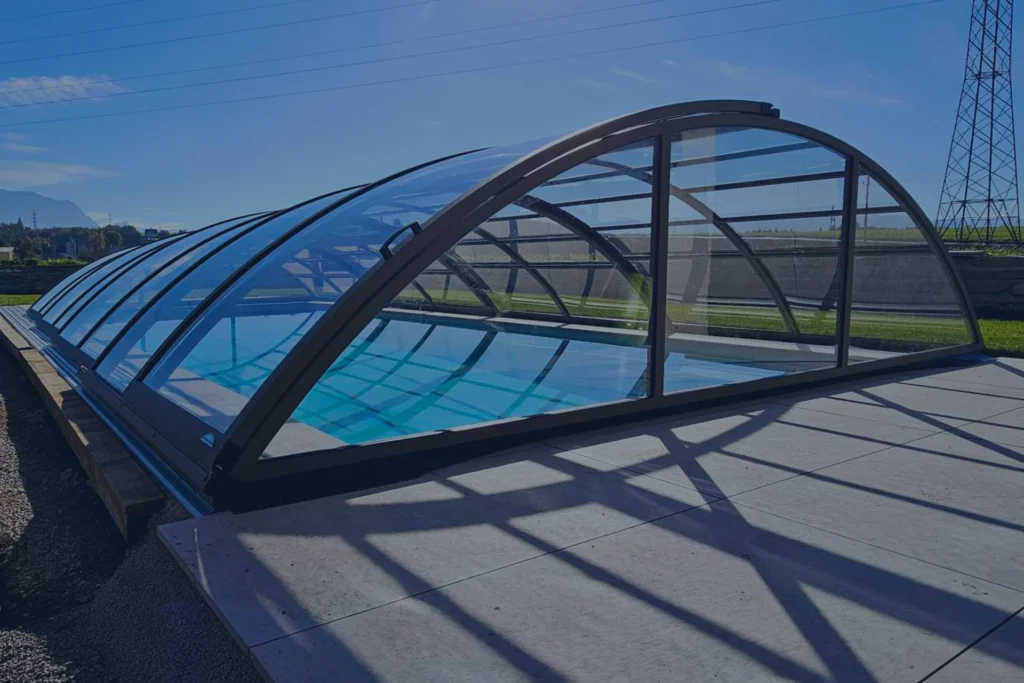
The hours of highest UV radiation intensity in the Polish summer climate are 10:00-16:00 — jak wskazuje Bioderma za rekomendacjami dermatologicznymi. To jest jednocześnie okno czasowe, w którym dzieci najczęściej chcą się kąpać: po śniadaniu, po drzemce, przed obiadem. Konflikt oczywisty: najbezpieczniejsze godziny dla skóry (rano do 10, popołudniu po 16) nie zawsze pasują do rytmu dnia rodziny.
Kluczowe fakty o UV w polskim lecie:
- UV Index w polskim lecie: w miesiącach czerwiec-sierpień UV Index na terenie Polski osiąga wartości 6-8 (wysoki-bardzo wysoki), a w upalne dni z bezchmurnym niebem może dochodzić do 9 (za IMGW).
- Odbicie od wody: powierzchnia wody w basenie odbija dodatkowe UV — dziecko pływające otrzymuje UV zarówno bezpośrednio z góry, jak i odbite od tafli.
- Mokra skóra przepuszcza więcej UV: krem SPF się rozpuszcza w wodzie mimo formuł wodoodpornych, wymagana jest reaplikacja co 2 godziny i po każdym wyjściu z wody (rekomendacja PTD).
Poliwęglan lity z filtrem UV — jak działa
W obudowach basenowych System Covers standardem jest poliwęglan lity 3 mm z obustronnym filtrem UV (opcjonalnie 4 mm za dopłatą). Filtr UV jest wbudowany w strukturę płyty na etapie produkcji przez wyspecjalizowanego producenta ze Szwecji, nie jest to powłoka nakładana wtórnie.
Konkretne fakty techniczne o poliwęglanie z filtrem UV (za Plexiart, Proplex, Arctom):
| Właściwość | Poliwęglan lity SC z filtrem UV |
|---|---|
| Blokada UV | Obustronny filtr UV, blokuje szkodliwe UVA/UVB |
| Przepuszczalność światła widzialnego | Wysoka — efekt „szklany”, dziecko może się bawić w naturalnym świetle |
| Odporność na fotodegradację | Nie żółknie, nie kruszeje przez 10-15 lat (Plexiart) |
| Odporność mechaniczna | Około 200× większa niż szkło (Tuplex, plytyplastikowe.pl) |
Obudowa jako dodatkowa warstwa cieniowania
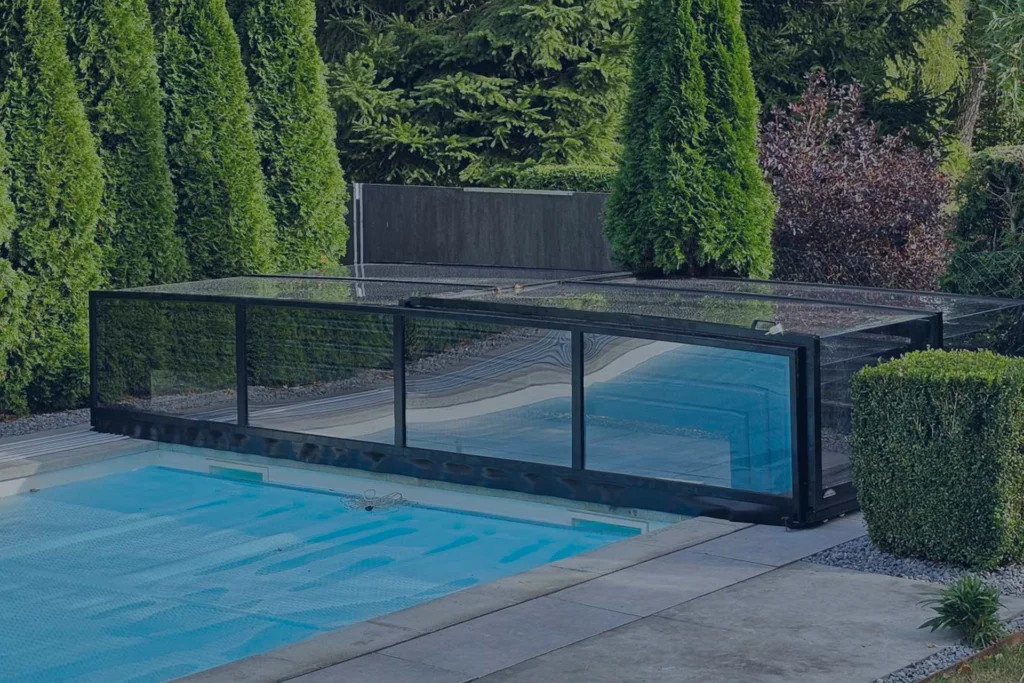
Key principle: the pool enclosure does NOT replace standard sun protection for children. SPF cream, UV clothing, a hat, and staying in the shade between 10:00 AM and 4:00 PM remain essential — the enclosure is an additional layer.
The role of the enclosure as a shading layer — in four contexts:
Peak hours (10-4)
When a child wants to swim in the middle of the day, the UV polycarbonate enclosure provides shade plus a barrier against harmful UV. The child still requires SPF + a hat, but there is less intense UV exposure.
Longer water play
SPF cream needs to be reapplied every 2 hours and after every exit from the water. Under the enclosure (less direct UV) — the safety window is larger, although reapplication is still necessary.
Small children (6 months – 3 years)
Dermatologists recommend maximum avoidance of direct sunlight for the youngest. The enclosure allows for pool use in a more controlled environment, limiting direct UV exposure.
Reflections from the water
The water surface reflects UV. UV polycarbonate above the surface reduces reflections from above and partially from the sides — decreasing cumulative exposure.
Practical guidelines for parents
The pool enclosure does not exempt you from caring for your child’s protection. Six practical rules for combining the enclosure with standard protection:
- SPF is still mandatory. SPF 50+ cream for children — apply 15-30 minutes before leaving home, reapply every 2 hours and after every exit from the water. The enclosure does not exempt you from this (PTD recommendations).
- UV clothing and a hat. UV-Protective clothing (UPF 50+) and a wide-brimmed hat are standard gear for a child at the pool — even under the enclosure.
- Hours 10-4 with caution. Even with the enclosure and SPF, on hot days limit time in the water during the middle of the day. Morning (before 10) and late afternoon (after 4) swims are safer.
- Children under 6 months — complete avoidance of sunlight. AAD recommendation: infants should not be exposed to direct sunlight. The enclosure does not change this rule.
- Consultation with a pediatrician. Children with skin conditions (eczema, UV sensitivity), taking phototoxic medications — additional recommendations from a pediatrician or dermatologist.
- Good habits for winter. PTD recommends year-round sun protection (SPF ≥ 15 in fall-winter). The enclosure used in cooler months allows for water activities without sacrificing protection.
More about child safety by the pool — in our article on securing the pool from children. Locks, anti-wind latches, and the design of the enclosure also serve a protective function against uncontrolled access of children to the water.
Which SC models are particularly suitable for families with children
In the offer of System Covers every model has solid polycarbonate with a double-sided UV filter as standard — there is no „budget” model without UV. For families with children, the choice of model mainly depends on the style of use:
Families with small children — Dominicana
SC bestseller. Height 60-80 cm provides full shade over the surface, children can play in the water while sitting or lying down. Two height options available to meet family needs.
Families with floating children — Rodos
Average height — swimming under the enclosure is fully comfortable, even for adults. Safe for longer summer swimming sessions.
Families who enjoy spending time by the pool — Tenerife
Walk-in height up to 230 cm — adults walk fully upright, children have complete freedom. The entire pool area becomes a shaded recreational space.
Structural safety for children — in every SC model as standard: 2× safety locks on each segment, 2× anti-wind locks, sliding doors with an optional key lock (for an additional fee — recommended for families with small children). Seals Durable EPDM resistant to pool chemicals.
Frequently Asked Questions (FAQ)
No. The enclosure is an ADDITIONAL layer of shading, it does not replace standard protection (SPF cream, UV clothing, hat, limiting peak hours). Recommendations from PTD and AAD regarding SPF remain in effect regardless of the use of the enclosure. This article contains general information — specific recommendations for your child should be consulted with a pediatrician or dermatologist.
Solid polycarbonate with a double-sided UV filter blocks harmful UV radiation while allowing visible light to pass through — confirmed by studies from Arctom, Plexiart, and Proplex. The specific percentage value of UV blockage is determined by the polycarbonate manufacturer (System Covers uses polycarbonate from Sweden) in the material’s technical data sheet. Documentation from the polycarbonate manufacturer is available upon request.
Yes, but still with SPF protection, a hat, and UV clothing. The hours of 10:00 AM to 4:00 PM are the period of highest UV intensity — the enclosure partially reduces it but does not eliminate it. Dermatological recommendations regarding limiting direct sun exposure during these hours remain in effect.
Recommendation from the American Academy of Dermatology (AAD): children under 6 months should NOT be exposed to direct sunlight. The enclosure does not change this rule. A pool for infants is an individual health issue — always consult with a pediatrician.
The UV filter is built into the structure of the polycarbonate sheet, it is not applied as a secondary coating. Manufacturers declare the effectiveness of the filter for a period of 10-15 years of outdoor use (according to Plexiart). In the construction of SC enclosures, the panel can be replaced with a new one at any time — spare parts are readily available (the system has not changed for 5 years).
SPF (Sun Protection Factor) describes how many times longer skin with the filter can withstand UV without reddening. UV Index (scale 1-11+) describes the intensity of UV at a given moment. Higher UV Index = greater need for protection. In summer in the Polish climate, the UV Index reaches 6-8 (high-very high), which requires SPF 30-50+ and limiting peak hours (according to IMGW and PTD).
Solid polycarbonate has some insulating properties, but under the enclosure on hot days it can be warmer than in open space (greenhouse effect). Good ventilation through sliding doors is important — fully opening one side allows for air circulation. Always monitor the child’s well-being and avoid long sessions on hot days.
3 mm polycarbonate is the standard for SC, while 4 mm is an optional upgrade. The material difference: greater mechanical resistance and better thermal insulation. From a UV perspective, both variants have the same double-sided filter. The choice of 4 mm mainly depends on the location (precipitation, snow) and preferences, not on the UV aspect.
Are you looking for a pool cover for a family with children?
The quote is free and non-binding. All System Covers models come with 3 mm solid polycarbonate with a double-sided UV filter as standard — without a „budget” version. We will advise you on the choice of model based on usage style and the age of the children, taking into account the safety of the structure.